On this page
Which software does an optical business need?
Ask two questions. Does anyone examine eyes on your premises? Does anyone other than the customer pay for the visit or the glasses? If both answers are no, optical retail software is all you need. It runs the counter: the spectacle order with the prescription, frame and lens stock, payments, receipts and the cash at the end of the day.
If you examine eyes, the examiner also needs a clinical record. If you bill insurers or vision plans, you need practice management software for appointments, eligibility checks and claims. In the United States the clinical record and practice management are commonly sold together as one suite, often with an optical module for the dispensary.
Does anyone examine eyes or test sight on your premises?
YesThe exam room needs a clinical record (an EMR or EHR). Go on to the next question.
NoNo clinical record is needed. Go on to the next question.
Do you bill insurers, vision plans or a public scheme for exams or glasses?
YesA practice that examines and bills needs practice management with eligibility checks and claims, commonly in the same suite as the EHR. If you only dispense, ask the plan or scheme how it takes claims for glasses before you choose software.
NoYou do not need claims software. Customers pay at the counter, and an examiner, if you have one, needs only a clinical record.
Do you sell frames, lenses or contact lenses?
YesYou need the dispensing side as well: orders, stock and receipts, from the suite's optical module or from separate optical retail software.
What are the five kinds of eye care software?
Vendors use these names loosely, and many products cover more than one job. Separate the jobs first, then check which product does which.
Optical retail POS
The till of an optical shop. It rings up frames, sunglasses, solutions and cases, takes cash or card, applies discounts, prints a receipt with your sales tax or VAT and shows what came in at the end of the day.
Dispensing and optical inventory
The spectacle order: the prescription for each eye, the frame and lenses, measurements such as PD, the advance and balance, the lab job and the delivery date. It also counts frames by model, colour and size and lenses by power. In most products made for optical shops, this and the POS are one program.
Optometry practice management
The front office of a clinic: the appointment book, patient registration, recall lists, fees, insurance eligibility, claims and reports per doctor. We found no official definition. ONC, the US health IT office (now part of ASTP/ONC), mentions it only in passing, as a "registration system or practice management system" that patient details can come from.
Clinical records (EHR or EMR)
The record of the examination: history, tests, findings, the prescription written and the plan. HealthIT.gov defines an EHR as software used to "securely document, store, retrieve, share, and analyze information about individual patient care".
Insurance claims and appointment workflows
The work between the practice and whoever pays. In the US, electronic claims to health plans use the HIPAA standard ASC X12N 837 version 5010, and eligibility checks use 270/271, as listed by CMS. Practice management software or a clearinghouse does this work.
EMR or EHR: is there a difference?
The two terms are often used as if they meant the same thing. ONC draws a line between them. An EMR is "a digital version of the paper charts in the clinician's office", while "EHRs are designed to reach out beyond the health organization that originally collects and compiles the information" (ONC, EMR vs EHR). The HealthIT.gov FAQ makes a similar point: "EHRs contain information from all the clinicians involved in a patient's care".
For an optical business, that difference matters less than the line between either of them and retail software. A prescription field on a sales order is not a clinical record of any kind.
Optician, optometrist, dispensing optician: who does what?
The word "optician" also means different jobs in different countries. Two official descriptions:
- United States. The Bureau of Labor Statistics says opticians "fit customers for eyeglasses and contact lenses and help them select which frames and lenses to buy", working from prescriptions written by optometrists and ophthalmologists. It also notes that some states require opticians to be licensed.
- United Kingdom. The careers page of the General Optical Council says an optometrist "examines eyes, tests sight and prescribes spectacles or contact lenses", and a dispensing optician "advises on, fits and supplies the most appropriate spectacles".
Who may test sight and fit lenses is set by local rules, so check them where you work. For software, the split is simpler: the person who examines eyes needs a clinical record. The person who fits and sells glasses needs dispensing and retail software. In a small business they can be the same person.
Which jobs does each type cover?
The table shows what each type usually covers. Products vary a lot, and many suites sold to US practices combine practice management and an EHR, so read "part" as "ask the vendor".
| Job | Optical retail | Practice mgmt | EHR |
|---|---|---|---|
| Sell frames and sunglasses | Main job | Via optical module | No |
| Prescription on the order | Per eye, on the order | Via optical module | Writes it, no sale |
| Lens and frame stock | By model and power | Via optical module | No |
| Barcode labels | Common | Some modules | No |
| Lab job cost | Cost line to full tracking | Some send orders | No |
| Receipts with tax | Every sale | Statements, invoices | No |
| Appointments and recalls | Usually not | Main job | Recall dates |
| Exam records | Not clinical | If suite has EHR | Main job |
| Insurance claims | Usually not | Eligibility, claims | Notes and codes |
| Patient portal | Usually not | Booking in some | Records in some |
No single column covers every row, so a practice that examines, bills insurers and sells glasses needs all three, from one vendor or several. The optical retail column is the only one a shop without an exam room needs, unless it bills a vision plan or public scheme for the glasses.
What passes from the exam room to the dispensing counter?
The exam room produces a prescription. The counter turns it into a pair of glasses. The prescription and the patient's details are what must cross over without a mistake.
Exam room: practice management and EHR
- Book the appointment and register the patient
- Check insurance eligibility (US)
- Record the history, tests and findings
- Refract and write the final prescription
- Bill the exam or send the claim
- Set the recall date
The prescription for each eye (sphere, cylinder, axis, ADD, any prism), its date and the examiner, with the patient's name and contact details
Dispensing counter: optical retail software
- Find the customer or add them
- Enter or check the prescription and measure the PD
- Choose the frame and lenses from stock
- Take the advance and promise a date
- Send the job to the lab and record its cost
- Collect the balance and print the receipt
When the two lanes run on different systems, someone types the prescription again. Mistakes happen here: a minus sign dropped from a cylinder, an axis of 18 typed as 180, an ADD put on the wrong eye.
Prescriptions also come in two forms. Some eye doctors, often ophthalmologists, write plus cylinder, while many optometrists and labs work in minus cylinder. Both describe the same lens, but the counter has to know which one it is reading. The guide to entering a prescription in optical software goes through each field and the usual mistakes.
Which setup fits your kind of business?
An independent optical shop with no exam room
Customers bring a prescription from an optometrist or an eye doctor, and you fit and sell the glasses. All of your work happens at the counter.
What you need: optical retail software with dispensing and stock. Look closely at the prescription fields for each eye, lens stock by power, the lab cost on each job, the advance and balance, and receipts with your tax. A practice suite would charge you for an appointment book and claims you would never use. If a vision plan or a public scheme pays for some of the glasses, check how the product records that payment and whether you also need the payer's own system. The questions to put to a vendor are in how to choose a POS system for an optical store.
A shop with an in-house optometrist or refractionist, and no insurance billing
Sight is tested in a room at the back, and patients pay at the counter as they would for any other purchase.
What you need: optical retail software for the counter, and a proper record of each examination. The prescription on the order is not that record. In the UK, for example, the General Optical Council's Standards of Practice for optometrists and dispensing opticians include standard 8, "Maintain adequate patient records". Check what your own regulator expects. A small clinical record system can be enough; you do not need claims software if nobody bills a third party.
A US optometry practice that bills vision plans
Exams are booked, eligibility is checked before the visit, and the exam, and in many cases the glasses, are billed to a vision plan or a medical insurer.
What you need: practice management and an EHR, nearly always as one suite, with an optical module or a linked retail system for the dispensary. Retail-only software, Asaan Optics included, does not replace them. The page on Asaan Optics in the United States lists what it does not do there.
A multi-branch optical chain
Several shops under one owner, sometimes with an exam room in some of them.
What you need: optical retail software that reports for each branch and for all of them together, with separate stock and staff logins per shop. Ask whether stock can be moved between branches in the software, whether a customer's prescription can be found from another branch, and what each extra branch costs. Branches with exam rooms also need a clinical record for those rooms, so check that a patient examined in one branch can be found at the counter of another.
An eyewear boutique or sunglasses store
Most sales are ready-made: sunglasses, fashion frames, cases and accessories. Prescription orders are a small share, or none at all.
What you need: a retail POS with stock by model, colour and size, and a barcode on every piece. If you take prescription orders, even a few a week, an optical product keeps the prescription and the open order on one record, where a general retail POS leaves that part on paper. The trade-off is set out in whether you need optical software at all, and a method for counting frames by colour and size is in how to manage optical inventory.
An ophthalmology or eye clinic with an optical counter
A medical clinic with its own dispensary. The clinic runs on a medical EHR and practice management system chosen for the doctors' work.
What you need: the clinic's EHR for the doctors, and dispensing software for the optical counter: either the EHR vendor's optical module or a separate retail system. Check the hand-off format closely, because prescriptions from ophthalmologists may be written in plus cylinder, and the counter and the lab must agree on how each one is read.
One suite or two systems?
Where a business needs both sides, the choice is between one product that does both and two products joined by the prescription.
What should you ask before buying either type?
A few points are set by law, and they differ by country: the tax rules for your receipts, your professional regulator's rules on records, and the privacy or data-protection law where you work. Prescriptions and exam results are health information, which such laws often treat with extra care. In the US, electronic claims also follow the HIPAA transaction standards above. Check each one with the official source or an adviser. The questions below are good practice, not legal requirements. Ask the vendor to show each answer on screen.
Questions about the clinical and retail split
- Which of the five jobs above does it do, and which need another product or a paid module?
- How is a prescription entered: separate fields for each eye, plus or minus cylinder, the ADD, PD and any prism?
- If the exam happens in another system, how does the prescription reach the order, and who checks it?
- Does each prescription keep the date it was written and the name of the examiner?
- For claims in the US: which payers, which transactions, through which clearinghouse, and at what extra cost?
- If a plan pays only for the glasses, does the product record that payment, or do staff use the plan's own system?
- What does each extra doctor or location add to the price, and is data conversion charged separately?
- Where are prescriptions and exam records stored, who can see them, and will the vendor sign any data-processing agreement your law requires?
- If you leave, how are exam records exported or kept for as long as your regulator requires?
General point-of-sale questions, such as billing when the internet drops, stock, receipts and getting your data out, are in the questions to ask before buying an optical POS.
Where Asaan Optics fits, and where it does not
Asaan Optics, which we make, is optical retail software for the counter: a Windows desktop program and an Android app on one shop account. Each order stores the spectacle prescription per eye (SPH, CYL, AXIS, VA and ADD) and the IPD, with the frame and lenses from stock, and several pairs can go on one bill. There is no prism field. Each order has a status (Pending, Completed, Cancelled) and a delivery date; there are no lab job stages. On the Windows desktop, outsourced lab work is billed to the lab's supplier account, and stock is managed there.
It has no appointment diary, recall reminders, insurance billing or electronic health records. The Android app has an eye-examination screening aid with acuity, pinhole, colour and Amsler tests. It is a screening aid, not a diagnosis, and not a clinical record.
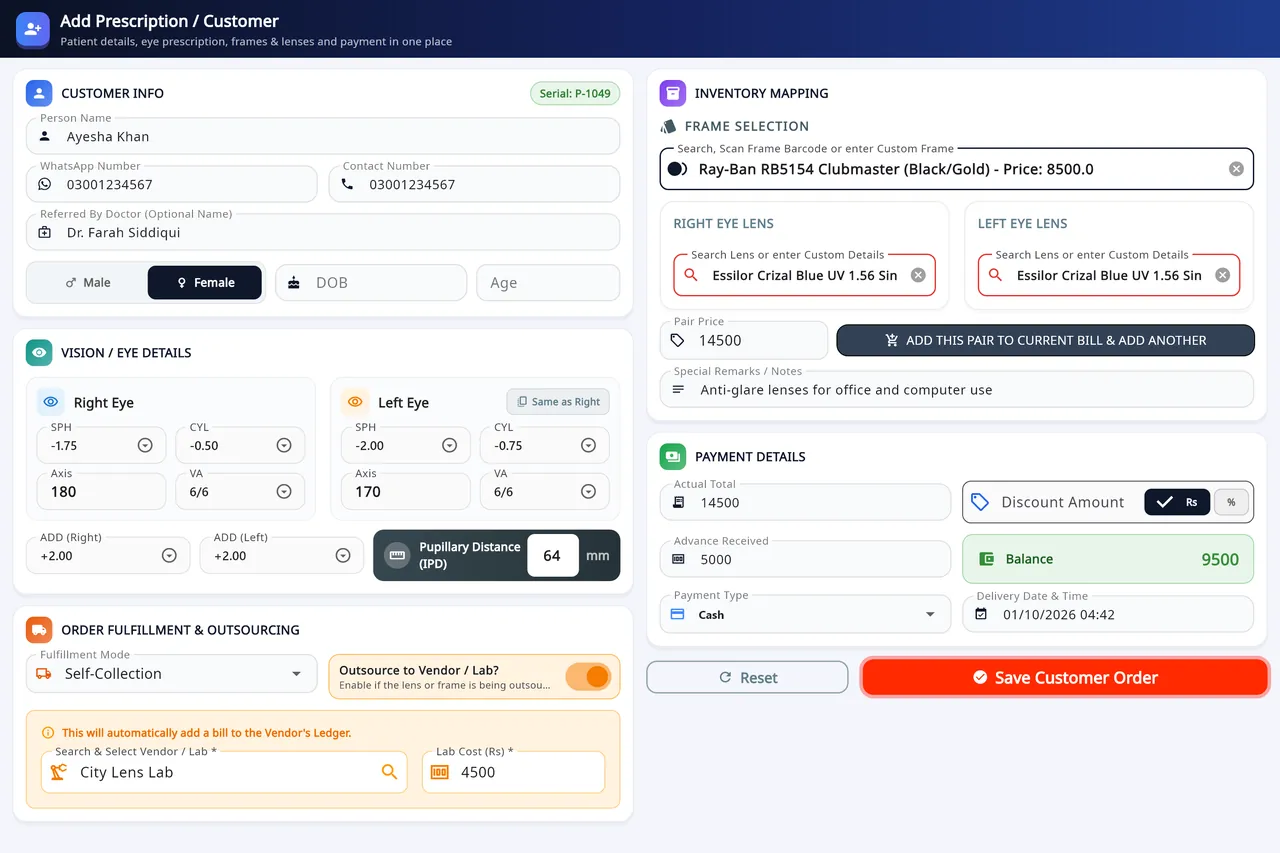
If your practice needs exam records, scheduling or claims, a clinical suite fits better. These pages set Asaan Optics beside three of them: Asaan Optics and RevolutionEHR, Asaan Optics and Eyefinity Encompass and Asaan Optics and Crystal PM. For a shop that only dispenses, the five optical shop software options compare retail products.
In short: the right software for each setup
Useful next steps
In Asaan OpticsPrescriptions and ordersSPH, CYL, AXIS and ADD for each eye plus the IPD on each order, the frame and lenses from stock, several pairs on one bill.See how it works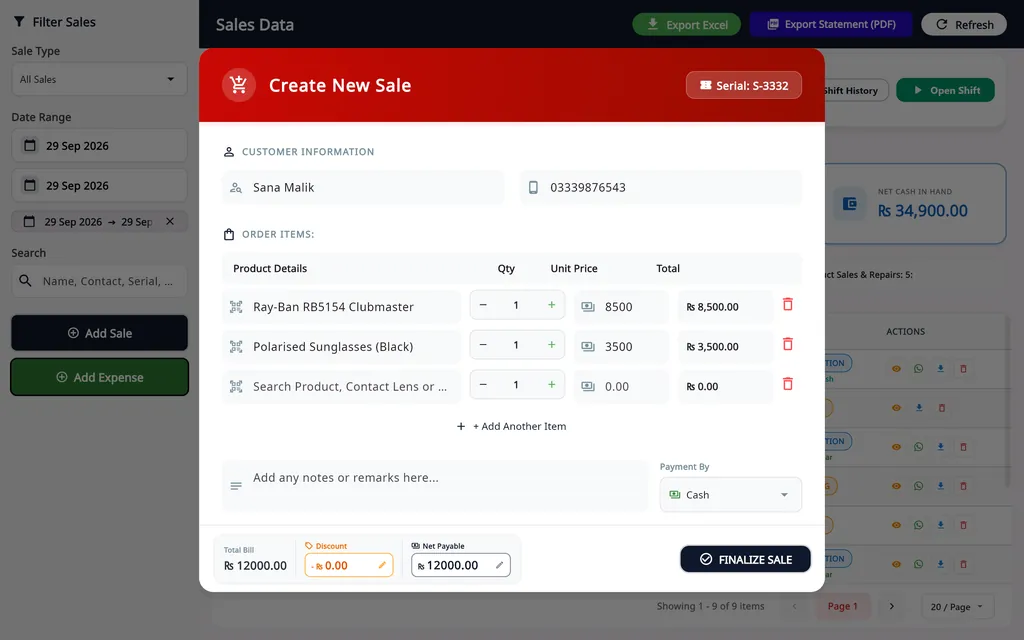 In Asaan OpticsOptical POS and billingCounter sales by barcode, prescription orders with advance and balance, receipts and shift reports.See how it worksFree calculatorTransposition calculatorTranspose a glasses prescription between plus and minus cylinder, for both eyes.Open the calculator
Questions and answers
Can an EHR work as the point of sale for my optical counter?
Only if it comes with an optical or retail module. A clinical record on its own does not ring up sales, count frames or print receipts with your sales tax, so a dispensary usually pairs it with point-of-sale and stock software.
Do I need practice management software with only one optometrist?
If that optometrist's appointments are booked in advance and the exams are billed to insurers, yes, because that is the work practice management does. If patients walk in and pay at the counter, a clinical record for the exam and retail software for the counter may be all you need.
Do HIPAA rules apply to an optical shop that never bills insurance?
The HIPAA transaction standards apply to health plans, clearinghouses and health care providers who conduct the adopted transactions electronically, such as claims to a health plan. Whether other HIPAA rules apply to your business is a question for a US lawyer or compliance adviser.
Can optical retail software keep a customer's prescription history?
Most keep each prescription with the order it was used for, so earlier prescriptions can be found under the customer. That is a dispensing history, not a clinical record of the examination.
Should I move old exam records into new retail software?
No. Keep exam records in a clinical system and follow your regulator's rules on how long they must be kept. Bring only what the counter needs, such as customer details and recent prescriptions, into the retail software.
Sources and references
Official and primary sources used for this article. Rules change: check the source before you rely on it.
HealthIT.gov (ASTP/ONC, US Department of Health and Human Services)
Electronic health records (Health IT Playbook)
Definition of an EHR as software used to document, store, retrieve, share and analyze information about individual patient care; content last updated 7 May 2025.
Checked 3 November 2026
HealthIT.gov (ASTP/ONC, US Department of Health and Human Services)
Health IT and HIE Frequently Asked Questions
Differences among electronic medical records, electronic health records and personal health records; last updated 1 April 2026.
Checked 3 November 2026
HealthIT.gov (ASTP/ONC), Peter Garrett and Joshua Seidman
EMR vs EHR: What is the Difference?
An EMR is the digital chart of one practice; an EHR is designed to share information beyond the organization that collected it. Published 4 January 2011.
Checked 3 November 2026
HealthIT.gov (ASTP/ONC)
Patient demographics and observations, 170.315(a)(5), Certification Companion Guide
Mentions a registration system or practice management system as a source of demographic data; no formal definition of practice management software was found. Last updated 14 May 2026.
Checked 3 November 2026
Centers for Medicare & Medicaid Services (CMS)
Adopted Standards and Operating Rules (HIPAA administrative simplification)
Health claims (institutional, professional, and dental): ASC X12N 837 Version 5010; eligibility and benefit inquiries: 270/271 Version 5010. The standards apply to health plans, clearinghouses and health care providers who conduct electronic transactions. Page modified 16 March 2026.
Checked 3 November 2026
U.S. Bureau of Labor Statistics
Opticians, Occupational Outlook Handbook
What opticians do in the US, that they work from prescriptions written by optometrists and ophthalmologists, and that some states require a licence. Last modified 27 August 2026.
Checked 3 November 2026
General Optical Council (UK)
What optometrists and dispensing opticians do in the UK.
Checked 3 November 2026
General Optical Council (UK)
Standards of Practice for optometrists and dispensing opticians
Standard 8: Maintain adequate patient records. The detailed guidance for each standard is on its own page.
Checked 3 November 2026