What is Optical Transposition?
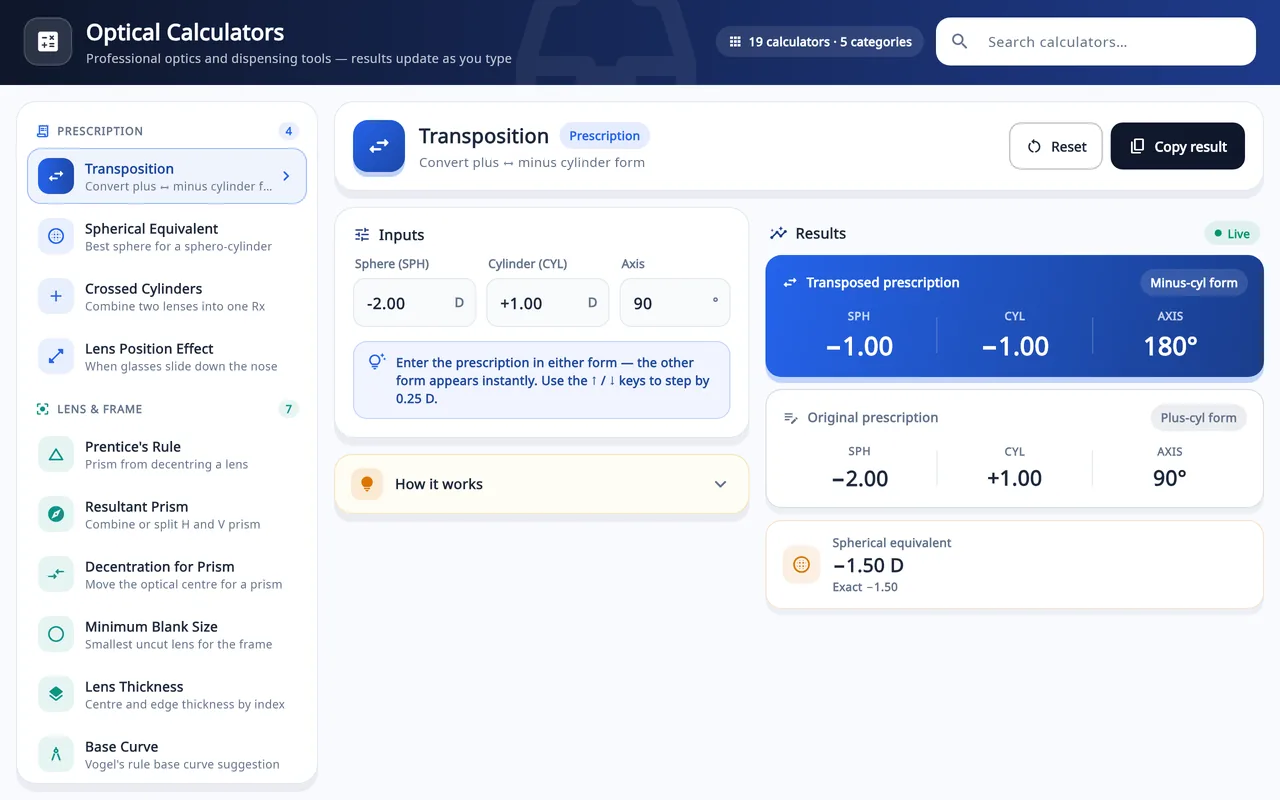
Optical transposition is the mathematical process of changing an eyeglass prescription from a minus cylinder format to a plus cylinder format, or the other way round, without changing the refractive power of the lens. Both formats describe the same physical lens; they are two ways of writing the same curves.
Ophthalmologists often write prescriptions in plus cylinder, while optometrists and most surfacing labs work in minus cylinder. Transposing a prescription correctly is a routine skill for every dispensing optician. If the columns on a prescription are unfamiliar, start with how to read an eye prescription.
The Mathematical Formula (Optical Theory)
Three rules, applied in this order. They work in both directions: plus to minus and minus to plus.
New SPH = SPH + CYL
New CYL = −CYL
New AXIS = AXIS ± 90°
- AXIS
- Add 90° if the axis is 90° or less; subtract 90° if it is more than 90°. The result always stays between 1° and 180°.
- SE
- SPH + CYL ÷ 2, shown under each eye. It is the same in either form.
Practical Example: Plus to Minus Cylinder Transposition
Original prescription, plus cylinder: +2.00 / +1.50 × 045.
- New SPH: +2.00 + (+1.50) = +3.50
- New CYL: +1.50 becomes −1.50
- New AXIS: 45 + 90 = 135
Transposed prescription, minus cylinder: +3.50 / −1.50 × 135. The calculator gives the same, with a spherical equivalent of +2.75.
Three prescriptions through the calculator
| Written | Calculator gives | SE |
|---|---|---|
| +2.00 / +1.50 × 45 | +3.50 / -1.50 × 135 | +2.75 |
| +4.00 / −1.50 × 120 | +2.50 / +1.50 × 30 | +3.25 |
| −1.25 / −0.75 × 180 | -2.00 / +0.75 × 90 | -1.63 |
Step-by-Step: How to Use This Calculator
- Select SPH and CYL for each eye, in 0.25 D steps. Choose 0.00 if there is no cylinder.
- Type the axis, from 1 to 180. It can stay empty when the cylinder is 0.00.
- Press Calculate Values. Each eye's transposed prescription and spherical equivalent appear on the right. An eye left completely empty stays blank.
The other calculators on this page
The tabs above hold three more quick calculators. Each has a full page of its own.
Understanding the Spherical Equivalent (S.E.)
The SE is the one sphere power that puts the circle of least confusion on the retina: SPH + CYL ÷ 2. It is shown next to every transposed eye and is used mostly for spherical soft contact lenses when the cylinder is small. The spherical equivalent calculator covers rounding and when not to use it.
Near and Intermediate Vision Calculator
The Near & Inter tab adds the full ADD to the distance sphere for reading glasses and half of it for computer glasses; cylinder and axis stay the same. The distance to reading converter does both eyes at once and explains the half-ADD rule.
Vertex Distance and Contact Lens Conversion
Above about ±4.00 D a contact lens needs a different power from the spectacles: less minus, or more plus. The Contact Lens tab applies F ÷ (1 − d × F) at 10, 12 or 14 mm and rounds to 0.25 D; the vertex distance calculator takes any pair of distances and shows the exact value.
Age-Based Reading ADD Estimator
The Age ADD tab suggests a starting ADD: +1.00 D at 40 to 42 years, rising by 0.25 D every three years to +2.50 D from 58. Under 40 it shows 0.00. It is only a starting point; the refraction decides the ADD.
Limitations
Transposition is exact: it rewrites the prescription without changing the lens. The spherical equivalent, the age-based ADD and the contact lens conversion are approximations that a qualified practitioner confirms before anything is ordered. The calculators do arithmetic on what you enter; see the medical disclaimer.
Watch: the same calculations in the Asaan Optics desktop app
This video works four examples in the desktop app's calculators, not in the calculators on this page. Transposition, the spherical equivalent and the spectacle to contact lens conversion use the same formulas as the tabs above; the app also rounds the spherical equivalent to 0.25 D, which this page does not. Crossed cylinders is a separate calculator on this site.
Video, 2 min 20 s
Four prescription calculations, each with one worked example you can check by hand: a transposition calculator turning +2.00 / -1.50 x 90 into +0.50 / +1.50 x 180, a spherical equivalent, a vertex distance calculation from spectacles at 12 mm to contact lens power, and two crossed cylinders combined into one lens. Results are rounded to 0.25 D, with the exact figure shown underneath.
Chapters
- 00:00Transposition worked example
- 00:31Spherical equivalent
- 00:52Vertex distance at 12 mm
- 01:27Crossed cylinders
What the video covers
- Transposition: +2.00 / -1.50 x 90 becomes +0.50 / +1.50 x 180 in plus cylinder form
- Spherical equivalent: -3.00 with -1.00 cylinder gives -3.50 D, and the app warns when the cylinder is above 0.75 D
- Vertex distance at 12 mm: -8.00 becomes -7.25 and -6.50 becomes -6.00 as contact lens powers
- Why the app flags powers of 4.00 D or more, where the vertex change matters
- Crossed cylinders: -3.00 / -1.00 x 180 with an over-refraction of +0.25 / -0.50 x 45 gives -3.00 / -1.00 x 13
- Why to read the exact figure under the rounded result before you decide
Transcript
Four prescription calculators, each with one worked example. These calculators support your judgement. They do not replace it.
Transposition opens first. It converts a prescription from one cylinder form to the other. Type plus two point zero zero, minus one point five zero. The axis is ninety. In plus cylinder form: plus zero point five zero, plus one point five zero, axis one eighty.
Spherical Equivalent gives the nearest single sphere, for example for a spherical contact lens. Type minus three point zero zero, and minus one point zero zero. The result is minus three point five zero. The cylinder is above zero point seven five, so the app warns that a sphere may blur vision.
Vertex Distance converts a spectacle power to a contact lens power, here at twelve millimetres. Enter minus eight point zero zero for the right eye, and minus six point five zero for the left, with no cylinder. Minus eight point zero zero becomes minus seven point two five. Minus six point five zero becomes minus six point zero zero. Remember this. The app marks powers of four dioptres or more as clinically significant. Below that, it says the change is usually insignificant.
Crossed Cylinders adds two lenses into one, for example an over-refraction on the current lens. Lens A is minus three point zero zero, minus one point zero zero, axis one eighty. Lens B is plus zero point two five, minus zero point five zero, axis forty-five. Combined: minus three point zero zero, minus one point zero zero, axis thirteen. The powers stay the same. The axis turns. Results are rounded to a quarter of a dioptre. Read the exact figure underneath before you decide. Four calculators, four worked examples. Type your own values, and the results update as you type.
Frequently Asked Questions (FAQs)
Why do ophthalmologists write prescriptions in plus cylinder while labs prefer minus cylinder?
Plus cylinder is the older clinical convention and is still common in ophthalmology. Most spectacle lenses are made with the cylinder curve on the back surface, which is written as minus cylinder, so labs usually ask for minus cylinder. Transposition converts one to the other without changing the lens.
Does transposing an optical prescription change how the patient sees?
No. Transposition only rewrites the prescription. +2.00 / +1.00 × 90 and +3.00 / −1.00 × 180 describe the same piece of glass or plastic, with the same powers in the same meridians.
What happens if the transposed axis exceeds 180 degrees or drops below 1 degree?
The axis is written on a 0 to 180° scale, and 0° is recorded as 180°. Adding 90° only to axes of 90° or less, and subtracting 90° from larger ones, keeps the result between 1° and 180°: 120° becomes 30°, and 90° becomes 180°. The calculator does this automatically.