On this page
What must an optical shop invoice show?
The same list works for a counter sale, a prescription order, contact lenses and a repair. Two kinds of rule decide the detail. Your country's tax law sets the legal minimum, usually once your shop is registered for VAT, GST or sales tax. Good practice adds what a spectacle order needs, and that protects you when a customer comes back with a question, even where the law does not ask for it.
What the law requires (depends on your country)
- The seller's registered name, address and tax number
- A unique, sequential invoice number and the date
- A description, quantity and value for each item
- The tax rate and the tax amount
- Buyer details for business customers or above a set value
- A QR code or electronic format, where the tax authority asks for one
Tax law sets the minimum; good practice adds what you need to make the right glasses and collect the right balance.
What good practice adds
- The customer's name and phone number on every order
- The frame, each lens and each coating on its own line
- The promised delivery date
- The advance, the balance due and how each amount was paid
- Your collection, remake and warranty terms
A note on words: a tax invoice is a document whose contents are fixed by tax law, while a receipt only proves a payment. Here "invoice" means the bill the customer takes away.
The eight parts of an invoice, from top to bottom
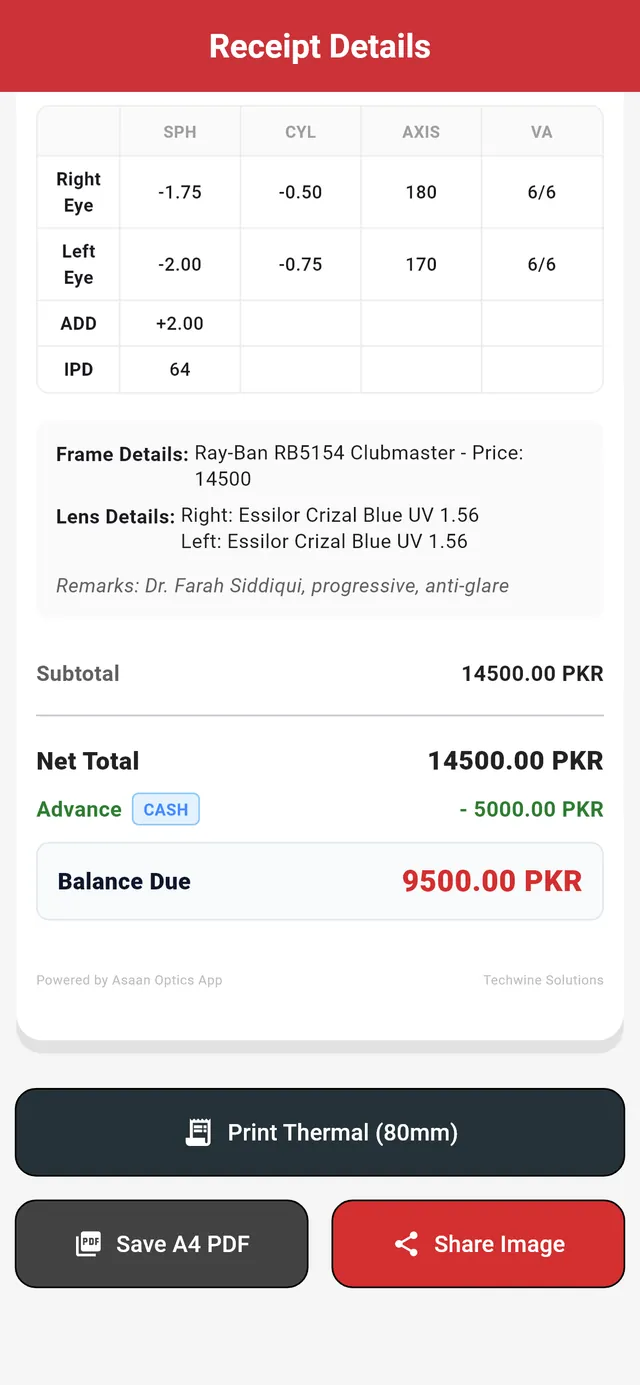
Most invoices follow the same order, whether they come off an 80 mm roll or an A4 printer. The sections after the diagram take the parts in the same order.
- 1
Seller details and tax number
The shop's registered name, address and phone, and its tax registration number if it has one.
- 2
Invoice number and date
A unique number in an unbroken sequence, the date of issue, and the delivery date if it is different.
- 3
Customer details
Name and phone for every order; address and tax number when the law or a business buyer needs them.
- 4
Item lines
Each frame, lens, contact lens, repair or service on its own line, with quantity and unit price.
- 5
Discounts and tax
The discount as its own line before tax, then the tax rate and the tax amount.
- 6
Totals
Subtotal, discount, value before tax, tax and the total to pay, in one named currency.
- 7
Payment: advance, balance, method
What was paid and when, how it was paid, and the balance still due.
- 8
Terms, notes and QR code
Delivery and collection terms, warranty notes, and a QR code where the tax authority requires one.
Seller details, invoice number and date
Seller details and tax number
Where the law applies: a registered shop prints the name and address it is registered under and its tax registration number. India's Rule 46 asks for the supplier's name, address and GSTIN. ZATCA's VAT invoicing guideline asks for the supplier's name, address and VAT number.
Good practice: add the phone number and, if you have several shops, the branch. Print the registered name where the rules ask for it, even if customers know you by a trading name.
Invoice number and date
The invoice number is how you and your accountant find a sale later. Four good-practice habits keep it useful:
- Unique. No two invoices share a number, even when two counters bill at once.
- Sequential. Numbers run in order with no gaps you cannot explain. Rule 46 asks for a consecutive serial number of up to sixteen characters, unique for a financial year.
- Never reused or deleted. A spoiled or cancelled invoice keeps its number and is marked as cancelled.
- Corrected with a credit note. If an issued invoice is wrong or the order is cancelled, issue a credit note that refers to the original number, then a new invoice if needed. Do not edit the old one. In Saudi Arabia a credit note without a reference to the original invoice breaks the VAT regulations, according to ZATCA's E-Invoicing Detailed Guideline.
Rules on separate number series differ. India's Rule 46 allows "one or multiple series", which suits a prefix for each branch. ZATCA's Phase 1 requirements list "multiple invoice sequences" among the functions an e-invoicing solution must not have. The E-Invoicing Detailed Guideline explains what that means: each e-invoicing unit, such as a till or a PC, keeps one unbroken sequence that cannot be reset. A shop with several tills has one counter per till, not parallel series on the same till. Ask your adviser before you start a second series.
Dates: print the date the invoice is issued. A prescription order is often delivered a week after it is taken, so print the promised delivery date as well. In Saudi Arabia a standard tax invoice shows the time of issue, and the date of supply when it differs from the issue date.
How much customer information does an invoice need?
Where the law applies: for an ordinary sale to an individual, little. A Saudi simplified tax invoice, the kind used for most retail sales, has no customer field in its minimum contents. India's Rule 46 asks for an unregistered buyer's name, address and state only when the taxable value is ₹50,000 or more, or when the buyer asks. Business customers are different: both countries want the buyer's name, address and tax number on an invoice to a registered business.
Good practice: record the customer's name and phone number on every prescription order anyway. You need them to call when the glasses are ready, to find the order when the customer returns, and to link the invoice to the prescription you measured. Collect what you use and nothing more; a date of birth or home address is rarely needed on a bill.
How should a spectacle order be described on the invoice?
Put each thing the customer pays for on its own line, with a quantity and a unit price. A single line that says "Glasses 12,000" is a common cause of disputes at collection: the customer remembers anti-reflection, the lab sheet says plain, and the bill cannot settle it. If you sell at a package price, still list what the package contains.
Frame, lenses and coatings
- Frame: brand, model number, colour code and size, for example 52-18-140 (eye size 52 mm, bridge 18 mm, temple 140 mm). Write "customer's own frame" when you only fit new lenses.
- Lenses: one line for each lens, or one line for the pair when both eyes get the same lens type. Give the design (single vision, bifocal or progressive), the material and index, such as 1.60, and the brand if the customer chose one.
- Coatings: anti-reflection, blue filter, photochromic or tint, inside the lens description or as their own priced lines. Separate lines show what each extra cost.
- Fitting: its own line if you charge for it, or a zero-price line if it is included.
| Item | Qty | Unit price | Amount |
|---|---|---|---|
| Frame, model 2041, black, 52-18-140 | 1 | 5,000 | 5,000 |
| Right lens, single vision 1.60, anti-reflection | 1 | 2,000 | 2,000 |
| Left lens, single vision 1.60, anti-reflection | 1 | 2,000 | 2,000 |
| Blue filter, both lenses | 1 | 1,000 | 1,000 |
| Fitting | 1 | 0 | 0 |
| Subtotal | 10,000 |
Contact lenses
Give contact lenses their own line with the brand and product, the pack size (for example, 30 daily lenses) and the number of boxes as the quantity. If the two eyes take different powers, use one line for each eye, so a reorder can be filled from the invoice. Keep the batch number and expiry date in your stock record rather than on the bill, in case a maker recalls a batch.
Repairs and other services
Describe the work, not only the price: "replace nose pads", "new left temple", "tighten and adjust". Eye tests, fitting fees and delivery charges are services, so give each its own line. Some tax systems treat services differently from goods, and the customer should see what each fee was for.
Where do discounts and tax go on the invoice?
Good practice: show a discount as its own line, with the amount or the percentage, instead of quietly lowering a price. It tells the customer what they saved and tells you later how much you gave away.
Where the law applies: in VAT and GST systems, a discount given at the time of sale normally comes off before the tax is worked out. Rule 46 asks for the taxable value after any discount, and ZATCA's VAT invoicing guideline says VAT is calculated on the value after discounts, with the discount shown on the invoice.
Show the tax rate and the tax amount, and where items carry different rates, the taxable value and tax for each rate. If your prices already include tax, say so and still show how much of the total is tax. The minimum contents of a Saudi simplified tax invoice allow either the VAT amount or a clear statement that the price includes 15% VAT, but the FAQ in the same ZATCA guideline says the invoice must include the value of the tax. Printing the amount is the safe choice.
Prices before tax (exclusive)
Subtotal: 10,000
Discount 10%: − 1,000
Taxable value: 9,000
Tax at 15%: 9,000 × 0.15 = 1,350
Total to pay: 10,350
Prices include tax (inclusive)
Price with tax: 11,500
Discount 10%: − 1,150
Customer pays: 10,350
Tax inside it: 10,350 × 15 ÷ 115 = 1,350
Value before tax: 9,000
Both methods reach the same figures; the invoice only has to say which one you use. The 15% is an example rate, not a recommendation.
Totals, advance and balance: what was paid and what is still due
Totals
The totals block should let anyone check the arithmetic: subtotal, discount, value before tax, tax and the total to pay. Name the currency once, next to the total.
Payment: advance, balance and method
Most prescription orders are paid in two parts: an advance when the order is taken and the balance at collection. The paper the customer holds in between is what they bring back, so it must show three figures: the order total, the advance paid and the balance due.
- Step 1
Order taken
Prescription, frame and lenses agreed; the total is fixed.
- Step 2
Advance receipt
Total, advance, balance due and the promised date.
- Step 3
Lab and fitting
The order number travels with the job.
- Step 4
Collection
The balance is paid and its method recorded.
- Step 5
Final invoice
Both payments listed; balance due 0.
Which document counts as the tax invoice, and when it must be issued, depends on your tax law. In India, a registered shop that receives an advance issues a receipt voucher for it under section 31(3)(d) of the CGST Act. Wherever you are, one order number should link the advance receipt, the lab job and the final invoice.
Record the method of each payment: cash, card, bank transfer or a mobile wallet. When the day's cash does not match, the payment method on each invoice is how you find the difference.
Terms, notes and the QR code at the bottom
The footer holds the conditions of the sale. For an optical shop the useful ones are:
- How long you keep orders that are not collected.
- Whether the advance is refunded if the customer cancels after the lenses are ordered.
- What your remake policy covers, for example trouble getting used to progressive lenses.
- The warranty on the frame and coatings, if you give one. The guide to warranties and protection plans for eyeglasses covers how to word it.
Write terms you can keep, in plain words, and check your local consumer rules before you print a blanket "no refunds" line.
QR code: some tax authorities require one. In Saudi Arabia a QR code is mandatory on simplified tax invoices, and the invoice type must appear as the title (ZATCA Phase 1 requirements). In India, Rule 46 includes a QR code with the Invoice Reference Number when the invoice is issued as an e-invoice under Rule 48(4). That applies only to businesses above a turnover threshold, and the GST section of the India page gives the current figure. Where no QR code is required, the space can hold a link to your shop's contact page.
Should the prescription be printed on the invoice?
It is optional. None of the tax rules cited in this guide lists the spectacle prescription among the contents of an invoice. The prescription is a customer record that belongs with the order. Printing it on the customer's copy lets them check the order and keep a record for their next pair, but there are reasons to leave it off:
- An invoice is often passed on: to an employer or insurer for reimbursement, to an accountant, or into a WhatsApp chat.
- A prescription is information about someone's health, which many people prefer to keep private.
- An old prescription printed on a new bill can be mistaken for the current one.
A simple rule works for most shops: keep the full prescription in the order record and on the lab job, and print it on the invoice only when the customer wants it, or hand over a separate prescription slip. A line such as "Prescription on file, measured 3 November 2026" links the two.
Thermal roll or A4: which paper should the invoice use?
Either works, as long as every required field fits and stays readable.
| Paper | Good for | Watch out for |
|---|---|---|
| 57 or 58 mm thermal | Quick counter sales | Long lens descriptions wrap onto several lines |
| 80 mm thermal | Most counter sales and orders | The print fades; keep a digital copy |
| A5 or A4 | Prescription orders, business customers, reimbursement claims | Needs an office printer; slower at the counter |
Thermal paper darkens with heat and its print fades with time and light, so do not treat the paper copy as your record. Keep every invoice in your billing software or as a PDF, for as long as your tax law requires. Before you go live, print a long order on your roll: a progressive lens with two coatings should still be readable. If lines are cut short or print too faintly, the guide to connecting a thermal printer covers setup and common faults.
Country rules in brief: India and Saudi Arabia
These two boxes give the key points only; follow the links for detail. For any other country, check your tax authority's invoice rules before you design your bill.
Checklist: before you print your first invoice
Run through this list when you set up a new shop, a new printer or new billing software.
Before you print your first invoice
- Your registered name, address and tax number print exactly as registered.
- Invoice numbers run in one unbroken sequence and cannot be reused.
- A cancelled sale is reversed with a credit note that refers to the original number.
- The tax label, rate and price style (inclusive or exclusive) match your registration.
- A discount prints as its own line, before the tax.
- The frame, each lens, coatings, contact lenses and repairs print on separate lines.
- Every order receipt shows the total, advance, balance due and payment method.
- The delivery date and your collection, remake and warranty terms are on the receipt or on a terms slip given with it.
- You have decided whether the prescription prints, and on which copy.
- A QR code prints if your tax authority requires one.
- A long order fits your paper size, and every invoice is also kept as a digital copy.
- Your accountant or tax adviser has seen a sample invoice.
What an Asaan Optics receipt shows, and its limits
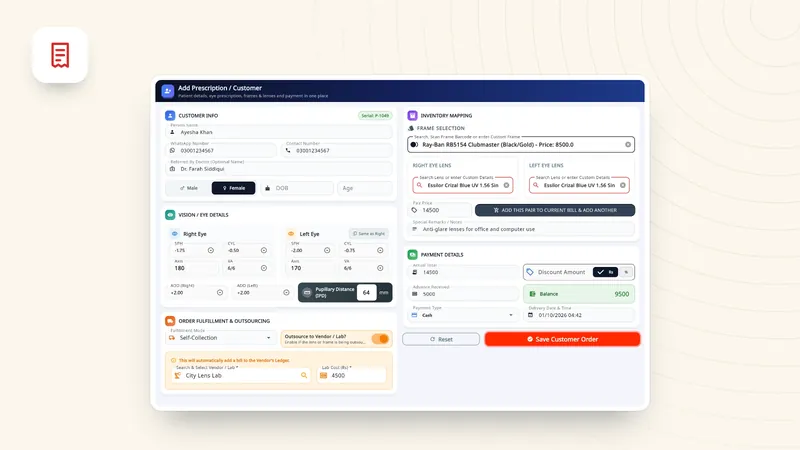
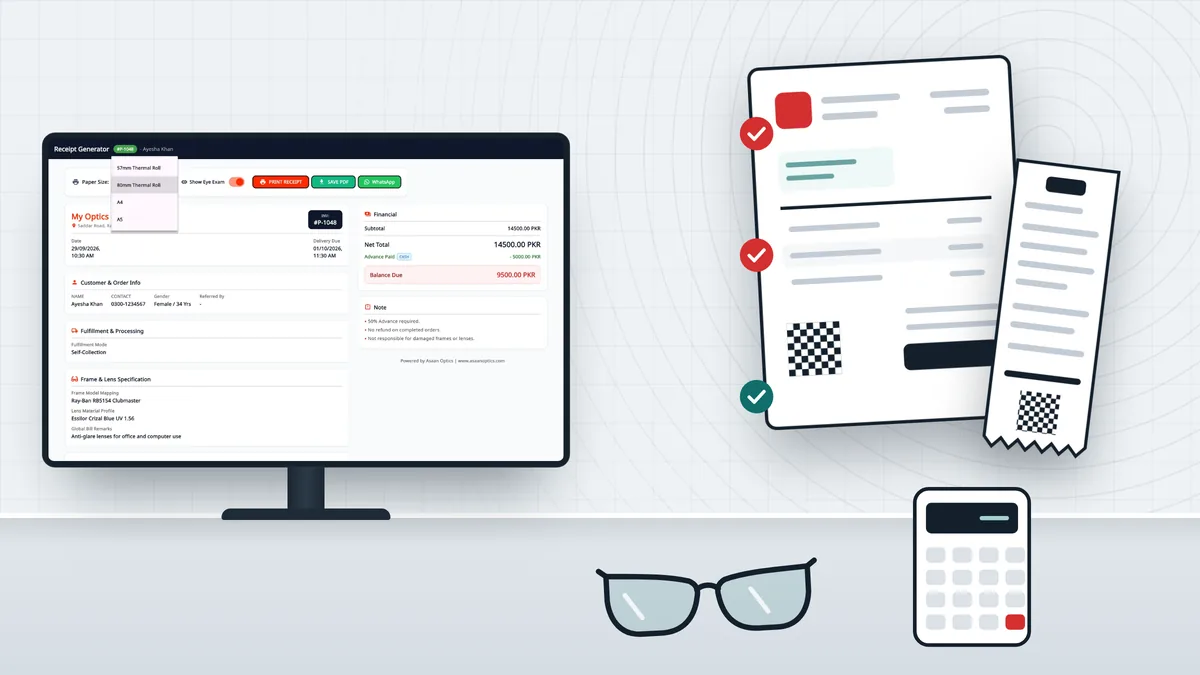
Asaan Optics is the billing software we make for optical shops, for Windows and Android. On the Windows desktop, a prescription order receipt covers most of the eight parts above: the shop's logo, name, address and phone; the tax registration number when tax is on and a number is set; the invoice number and date; the customer; the frame and each lens with quantity and price when they are priced separately (for example, picked from stock), otherwise the frame and lens details with one total, or the repair details; subtotal, discount, total before tax, a tax line with your label and rate, and the net total; the advance paid, balance due and payment method; fixed footer notes such as "50% Advance required." and "No refund on completed orders."; and a QR code, which can be a ZATCA-format QR code, a link to the shop's WhatsApp, or none.
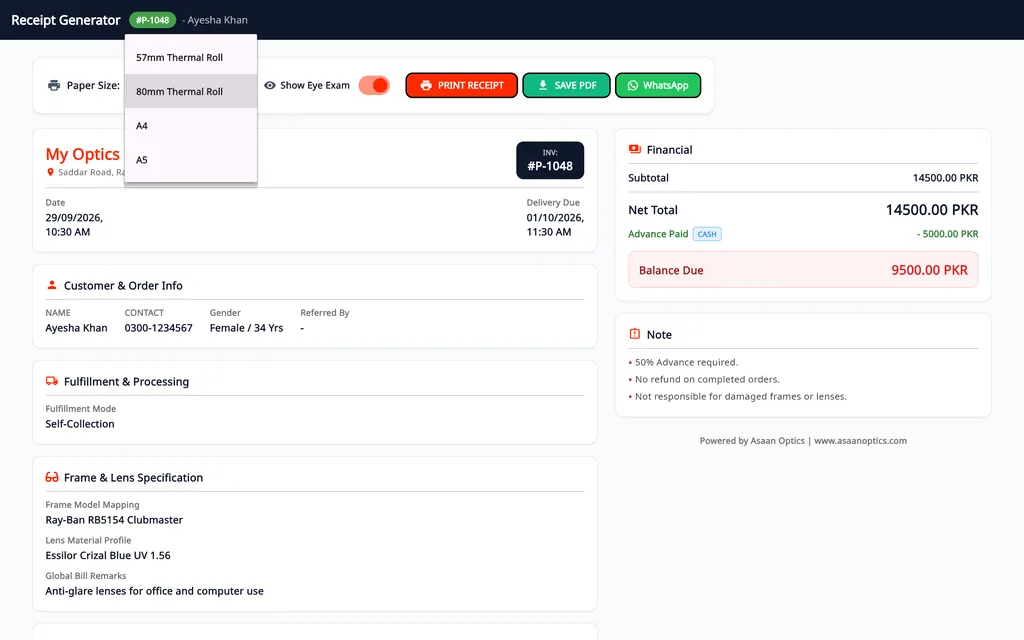
The prescription prints only when Show Eye Exam is switched on. Gender and age print when they are entered, so leave them blank if you do not want them on the bill. Receipts print through any printer installed in Windows, on 57 or 80 mm thermal rolls or A4 and A5 paper, and save as a PDF. The WhatsApp button opens the customer's chat with the message written; you press send. The full workflow, from order to collection day, is in how a spectacle bill is made in Asaan Optics.
Know its limits before you plan around it:
- One tax label and one rate per shop, with prices inclusive or exclusive of tax. Saudi shops can bill chosen item types at 0%, for supplies the law zero-rates; check with your adviser before you use it.
- In India you can name the tax GST and print one GST rate and your registration number. It does not split CGST and SGST, keep HSN codes or produce GST returns, so for a registered shop the receipt alone does not carry every Rule 46 particular of a tax invoice. Ask your accountant how to issue the tax invoice.
- Coatings are part of the lens description, not separate priced lines.
- An order takes one advance, and the balance is cleared in one go when the order is marked Completed. There is no box for a part payment, and the receipt shows one payment method, not a dated list of payments.
- The footer notes are fixed text. You cannot add your own collection, remake or warranty terms, so give those to the customer separately, for example on a printed terms slip.
- Outside ZATCA e-invoicing there is no credit note or customer refund flow. Only the owner can void a bill, with a reason, and the void is logged in Staff Audit. With ZATCA Phase 2 on, credit notes are issued automatically.
- In Saudi Arabia, ZATCA Phase 2 e-invoicing (Fatoora) runs on the Windows desktop (6.7.1 or later) and in the Android app (4.10.0 or later), once it is turned on and each PC or phone is connected with its own one-time password from the Fatoora portal; on the phone, invoices are sent while the app is open. The VAT, GST and ZATCA settings page describes the set-up.
If you are comparing systems, ask every vendor to print a sample invoice with your own shop details. More questions to ask are in how to choose an optical POS system.
The short version
Useful next steps
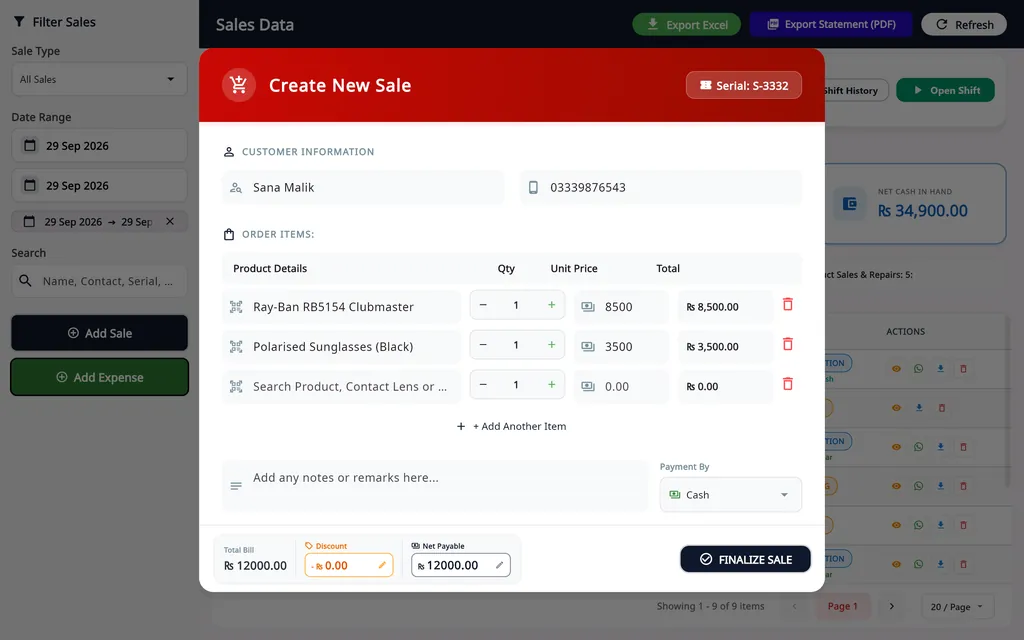 In Asaan OpticsOptical POS and billingCounter sales by barcode, prescription orders with advance and balance, receipts and shift reports.See how it works
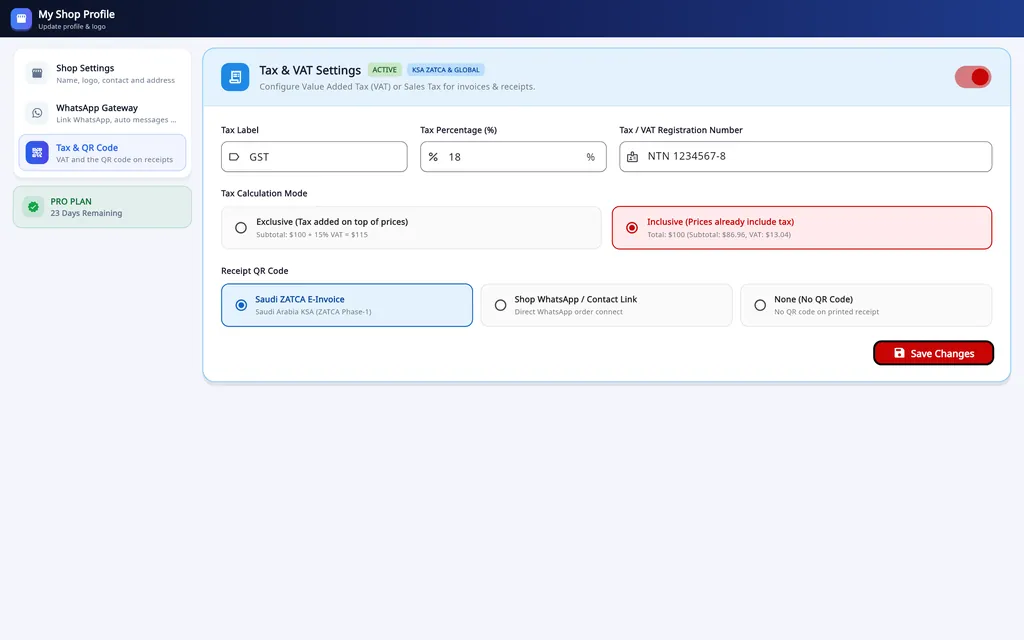 In Asaan OpticsVAT, GST and ZATCA settingsYour own tax label, one rate and your registration number on the receipt; ZATCA Phase 2 on the Windows desktop and the Android app for Saudi shops.See how it works
Questions and answers
Can one printed document be both the receipt and the tax invoice?
It can, if it carries every field your tax law requires for a tax invoice and also shows the payment. Some rules expect a separate document for some payments, such as the receipt voucher for an advance in India, so check what your tax authority accepts.
Can I still use a handwritten bill book?
It depends on the country. In Saudi Arabia, resident VAT-registered businesses have had to generate invoices electronically since 4 December 2021, and ZATCA says a handwritten invoice is not an e-invoice. Elsewhere, ask your tax authority whether a numbered bill book with all the required fields is still accepted.
Do I need an invoice for a free repair or a warranty replacement?
Record it on an invoice at zero price, or at the normal price with a full discount, so your stock, repair history and warranty records stay complete. Whether a tax document is needed for a free supply depends on your tax law.
What should the invoice show if my shop is not registered for tax?
Your shop name, address and phone, a sequential number, the date, the items and the total. Do not add a tax line or a tax number unless you are registered to charge tax, and check when registration becomes compulsory in your country.
What if a customer never collects their glasses?
The advance receipt and your printed terms are your record. State on the receipt how long you keep uncollected orders and what happens to the advance, call the customer before that date, and note each call on the order.
Sources and references
Official and primary sources used for this article. Rules change: check the source before you rely on it.
Central Board of Indirect Taxes and Customs (CBIC), Government of India
Rule 46: Tax invoice, Central Goods and Services Tax Rules, 2017
The particulars a GST tax invoice must contain, and the consolidated daily invoice for small sales. Latest amendment shown: Notification 20/2024-CT, effective 1 November 2024.
Checked 3 November 2026
Central Board of Indirect Taxes and Customs (CBIC), Government of India
Section 31: Tax invoice, Central Goods and Services Tax Act, 2017
31(3)(b): no tax invoice needed below two hundred rupees, on conditions; 31(3)(c): bill of supply; 31(3)(d): receipt voucher for an advance payment.
Checked 3 November 2026
Zakat, Tax and Customs Authority (ZATCA), Saudi Arabia
Guideline for Tax Invoicing and Records under VAT Provisions (Version 3, May 2026)
Contents of a tax invoice and a simplified tax invoice, when each may be issued (SAR 1,000), the Arabic language rule and the 15% basic rate; FAQ 7 (the tax value must appear) and FAQ 8 (VAT after discounts). The Arabic version prevails.
Checked 3 November 2026
Zakat, Tax and Customs Authority (ZATCA), Saudi Arabia
Phase 1 (generation) from 4 December 2021; Phase 2 (integration) from 1 January 2023 in waves. Page last updated 10 August 2026.
Checked 3 November 2026
Zakat, Tax and Customs Authority (ZATCA), Saudi Arabia
E-invoicing Phase 1: how to prepare
Stop issuing manual invoices (handwritten invoices are not e-invoices); QR code mandatory on simplified tax invoices; the invoice type as title; the buyer's VAT number on tax invoices; prohibited functions such as multiple invoice sequences. Page last updated 10 August 2026.
Checked 3 November 2026
Zakat, Tax and Customs Authority (ZATCA), Saudi Arabia
E-Invoicing Detailed Guideline (Version 2, May 2023)
An e-invoicing solution unit must not generate more than one invoice sequence at a time, and its counter must not be reset; example of a retailer with 12 cash registers; a credit note must refer to the original invoice (Article 54 of the VAT Implementing Regulations).
Checked 3 November 2026
Zakat, Tax and Customs Authority (ZATCA), Saudi Arabia
ZATCA announces the 25th wave of e-invoicing integration
Businesses with VAT-subject revenue above SAR 187,500 in 2022, 2023, 2024 or 2025 must integrate with Fatoora by 1 February 2027. Published 24 July 2026.
Checked 3 November 2026