The short answer
A protection plan for glasses is a paid promise from the shop, or from a company working with the shop, to repair or replace the customer's glasses if something goes wrong during a set period. It is sold separately from the glasses, for an extra price. That makes it different from two things the customer already has:
- The customer's legal rights. In most countries the law already says that goods must be fit for use and as described, and that a faulty item must be put right. A plan cannot remove or replace those rights.
- The warranty that comes with the product. A frame or lens maker's defect warranty, or the shop's own free guarantee, is included in the price.
The US Federal Trade Commission (FTC) draws the same line: "Service contracts, unlike warranties, are purchased separately from a product." Its consumer guidance adds that a plan is "not a good value if it doesn't offer more coverage than the warranty that came with the product."
So a plan is only worth selling if it covers something the law and the maker's warranty do not, usually accidental damage. Before you sell one, check two legal questions for your country: what the law says about warranties and plans, and whether a paid cover against damage or loss counts as insurance. In Saudi Arabia, for example, the Insurance Authority says an extended warranty is an insurance product that only licensed insurers may sell. The rest of this guide covers what a plan can include, the law in each market we could check, how to price it from your own records, and how to run claims.
Three layers of cover a customer can have
Keep the three apart in your own head and in what you tell customers. Most disputes about plans come from mixing them up.
| Layer | Who gives it | Costs the customer extra? | What it usually covers |
|---|---|---|---|
| Legal (statutory) rights | The law, against the shop that sold the goods | No | Faulty goods, goods not as described or not fit for their purpose. Cannot be taken away by a sign or a contract term in the countries checked below. |
| Product warranty or guarantee | The frame or lens maker, or the shop, free with the sale | No | Manufacturing defects for a stated period, for example a coating that peels or a weld that breaks on its own. |
| Protection plan, extended warranty or service contract | The shop, or a separate company or insurer | Yes | Whatever its written terms say: often accidental breakage, scratches or a longer defect period. |
The UK's Trading Standards guidance for businesses says it plainly: "The consumer's statutory rights are with the trader that sold the goods to them", and a manufacturer's guarantee "is in addition to such rights". A plan sits on top of the same rights. It does not replace them.
What a plan for glasses can cover
There is no standard plan. Decide each of these points and write the answer down before you sell the first one:
- What is covered. Common choices are accidental breakage of the frame, damage to the lenses, lens scratches, and repairs such as hinges, screws and nose pads. Say whether the plan covers the frame, the lenses, or both.
- What is excluded. For example loss and theft, damage on purpose, normal wear, a change of prescription, and lenses or frames bought elsewhere. Loss and theft deserve extra care: replacing glasses the customer no longer has is the kind of cover that regulators tend to treat as insurance (see "When a plan becomes insurance" below).
- How long it lasts. A start date (the sale date) and an end date, printed on what the customer takes home.
- What a claim costs the customer. Many plans charge a fee for each claim. The FTC tells buyers to look for "deductibles or fees you must pay each time the product is serviced", so if you charge one, state it.
- How many claims. One replacement, two, or unlimited repairs; say which.
- What the customer gets. A repair, the same model if it is still made, or a frame of similar price, and who decides.
- Who stands behind it. Your shop, or another company. The FTC's point applies anywhere: a plan "is only as good as the company that's responsible for coverage".
Lens makers often give their own warranty on coatings. Check what the lens supplier's warranty already covers before you charge for the same thing in a plan.
What the law says, country by country
These are the official sources we could open on 1 November 2026, with what each says that matters to a shop selling a plan. They are a starting point, not legal advice. Laws change, and a lawyer or your trade body in your country can confirm how they apply to you. Full links are under Sources at the end.
United States
- The FTC's Businessperson's Guide to Federal Warranty Law says that if you offer a service contract, the law "requires you to list conspicuously all terms and conditions", in plain language.
- A seller that makes its own service contract on a product cannot disclaim or limit the implied warranties on that product.
- Written warranties on consumer products costing more than $15 must be available to customers before they buy, and retailers "must make written warranties available at the point of sale".
- Conditions that tie warranty cover to buying something from a particular company ("tie-ins") are generally not allowed.
The guide adds that state law varies and points businesses to a private attorney or the state attorney general. We did not check state rules on service contracts.
United Kingdom
- Under the Consumer Rights Act 2015, goods must be of satisfactory quality (which includes durability and freedom from minor defects), fit for purpose and as described (sections 9 to 11).
- The customer has a short-term right to reject faulty goods within 30 days, then a right to repair or replacement (sections 19, 22 and 23). A fault that appears within six months is taken to have been there at delivery, unless the shop shows otherwise or that rule does not fit the kind of goods or fault (section 19).
- A contract term cannot exclude or restrict these rights (section 31). Trading Standards adds that "a 'no refunds' notice is not permitted".
- A guarantee given without extra charge must be in plain language, say that the customer's statutory rights are not affected, and give the guarantor's name and address, how long it lasts and where it applies (section 30). That section is about free guarantees; following the same rules for a paid plan costs nothing and avoids confusion.
India
- The Consumer Protection Act, 2019 lists as unfair trade practices a warranty or guarantee that is "materially misleading", or a promise to repair or replace where "there is no reasonable prospect that such warranty, guarantee or promise will be carried out" (section 2(47)).
- Not issuing a bill, cash memo or receipt is also an unfair trade practice, as is refusing to take back defective goods and refund them within the period on the bill, or within 30 days if the bill says nothing (section 2(47)).
- Insurers registered with IRDAI sell "extended warranty insurance" products; one such policy wording is on IRDAI's website. We found no official statement on whether a shop's own plan counts as insurance, so ask before you sell cover for loss or accidental damage.
Pakistan
- The Punjab Consumer Protection Act 2005, as amended in 2025, requires a receipt showing the date, the goods, the quantity and price, and the seller's name and address (section 19).
- The return and refund policy must be shown to the buyer before the sale, "by means of a sign at the point of purchase" (section 20).
- Liability for defective goods and services "shall not be limited or excluded by the terms of any contract or by any notice" (sections 12 and 17), and a false or misleading statement about a guarantee, right or remedy is prohibited (section 21).
This Act applies in Punjab. We could not open an official copy of the Islamabad Consumers Protection Act 1995 and did not check the other provinces' laws, or any SECP rule on insurance.
Saudi Arabia
- The Insurance Authority announced on 31 March 2026 that the extended warranty "is an insurance product that is exclusively offered in the Kingdom by licensed and registered insurance companies". Selling it without a licence, by car dealers, retail companies "and all other entities", violates the Cooperative Insurance Companies Control Law, with a fine of up to SAR 2 million, imprisonment of up to four years, or both. The announcement does not name glasses, so ask the Authority before you sell any paid cover.
- The Ministry of Commerce's consumer guide (2023) says the invoice must be numbered, in Arabic, and show the business, the date, the item and the total with VAT. For goods made for the customer, as prescription glasses are, the agreed terms and specifications go on the invoice or in a separate agreement the customer receives a copy of.
- For online sales, the E-Commerce Law requires the seller to state any warranty details before the contract (article 7).
Canada and the UAE
Ontario's government page on returns and warranties describes an extended warranty as the same promise over a longer period that "usually costs extra", and tells consumers to understand its terms before signing. We did not open federal or other provincial sources. For the UAE we could not open an official copy of the consumer protection law, so this guide says nothing about it.
When a plan becomes insurance
This is the question to settle before anything else, because selling insurance without a licence is a serious offence in many countries.
- Saudi Arabia answers it directly: an extended warranty is insurance and only licensed insurers may offer it (above).
- United Kingdom: the regulator's perimeter guidance on what counts as a contract of insurance (PERG 6 in the FCA Handbook) is the place to look. An older version we could read (2005 text) said a simple seller's warranty is unlikely to be insurance, but cover given by a third party, cover much wider or longer than a seller's usual obligations, or a promise to indemnify against loss or damage points towards insurance. We could not read the current FCA text, so check it yourself.
- India: extended-warranty cover is also sold as insurance by registered insurers. Whether a shop's own plan is insurance was not answered by any official source we found.
- Elsewhere: ask your insurance regulator.
The safest shapes, where the law allows them, are a free guarantee that is part of the price of the glasses, or a plan underwritten by a licensed insurer that your shop sells under that insurer's terms. A plan you write yourself that pays out for loss, theft or accidental damage is the shape most likely to be treated as insurance.
How to price a plan from your own records
We could not find an official source for typical plan prices, claim rates or take-up, and we do not quote figures from sales blogs. Use your own shop's numbers instead:
- Count past claims. From your repair records for the last 12 months, count the repairs and remakes that the plan would have covered, and the number of pairs they came from.
- Cost an average claim. Parts, lab charges and lenses at your cost, plus the staff time to handle it.
- Work out the expected cost per plan. Claims divided by pairs, times the average claim cost.
- Take off the claim fee if you charge one, then add a margin you are comfortable with.
Example, with made-up numbers to show the arithmetic (not a benchmark): a shop's records show 24 covered repairs for 300 pairs sold in a year, and an average covered repair costs the shop 1,200 in its currency. The expected cost is 24 ÷ 300 × 1,200 = 96 per plan. With a claim fee of 200 on each of those 24 claims, the shop collects 24 × 200 ÷ 300 = 16 per plan back, so the net expected cost is 80. A plan priced at 150 would leave 70 per plan to cover handling and risk, if the customers who buy the plan claim at the same rate as everyone else.
That last condition matters: people who expect to break their glasses are more likely to buy cover, so plan holders often claim more. Review the numbers after six months of real sales and adjust.
Tax on the plan depends on your country and on whether the plan is a service or insurance. Ask your accountant before you set the price.
Write the terms, then run claims the same way every time
A one-page terms sheet the customer can take home avoids most arguments. Put on it:
- the shop's name and address, and who is responsible for the plan;
- what is covered and what is not, in plain words;
- the start and end dates, and the receipt number;
- the claim fee and the number of claims allowed;
- how to claim: bring the glasses and the receipt to the shop;
- a sentence that the customer's legal rights are not affected by the plan.
Show the terms before the customer pays. The US rules on written warranties, the Punjab rule on return policies and the Saudi rule on warranty details all point the same way: the customer should know the terms before buying.
When a customer claims:
- Find the original sale by receipt number or phone number, and check the dates.
- Look at the glasses with the customer and decide whether the damage is covered. If it is a defect the law or the maker's warranty already covers, handle it under those, not the plan.
- Record the claim with its own receipt, the claim fee if any, and the work promised.
- Tell the customer when it will be ready, and keep the record of every claim. Those records are what you will price the plan from next year.
Offering it at the counter without pressure
- Offer the plan after the customer has chosen the frame and lenses, not before.
- Describe it in one sentence: what it covers, for how long, and what a claim costs.
- Never say or suggest that the plan is required, or that the customer has no rights without it. In India a misleading guarantee is an unfair trade practice; in the UK, terms that restrict statutory rights do not bind the customer.
- Do not make other cover depend on buying from you. In the US, tie-in conditions are generally not allowed.
- If a customer says no, finish the sale the same way. A shop that sells the plan honestly will get claims it is glad to pay, and customers who come back.
Recording plans and claims in Asaan Optics
Asaan Optics has no protection-plan or warranty feature: no plan register, no automatic end date and no claim count. What the Windows desktop does let you do today:
- Sell the plan on the bill. In Create New Sale, type the plan as its own line, for example "Breakage cover, 12 months", with its price. A line you type, rather than pick from the stock list, does not change stock. If the glasses were billed as a prescription order, sell the plan as a separate counter sale to the same customer.
- Print the key terms. Put the end date, the claim fee and the receipt number of the glasses in the sale's remarks; the remarks print on the receipt. Hand over the full terms sheet with it.
- Record each claim as a repair job. A repair has its own serial number and receipt, with the advance and the balance, and from the repair receipt you can send the customer a pickup message on WhatsApp. See repair job tracking.
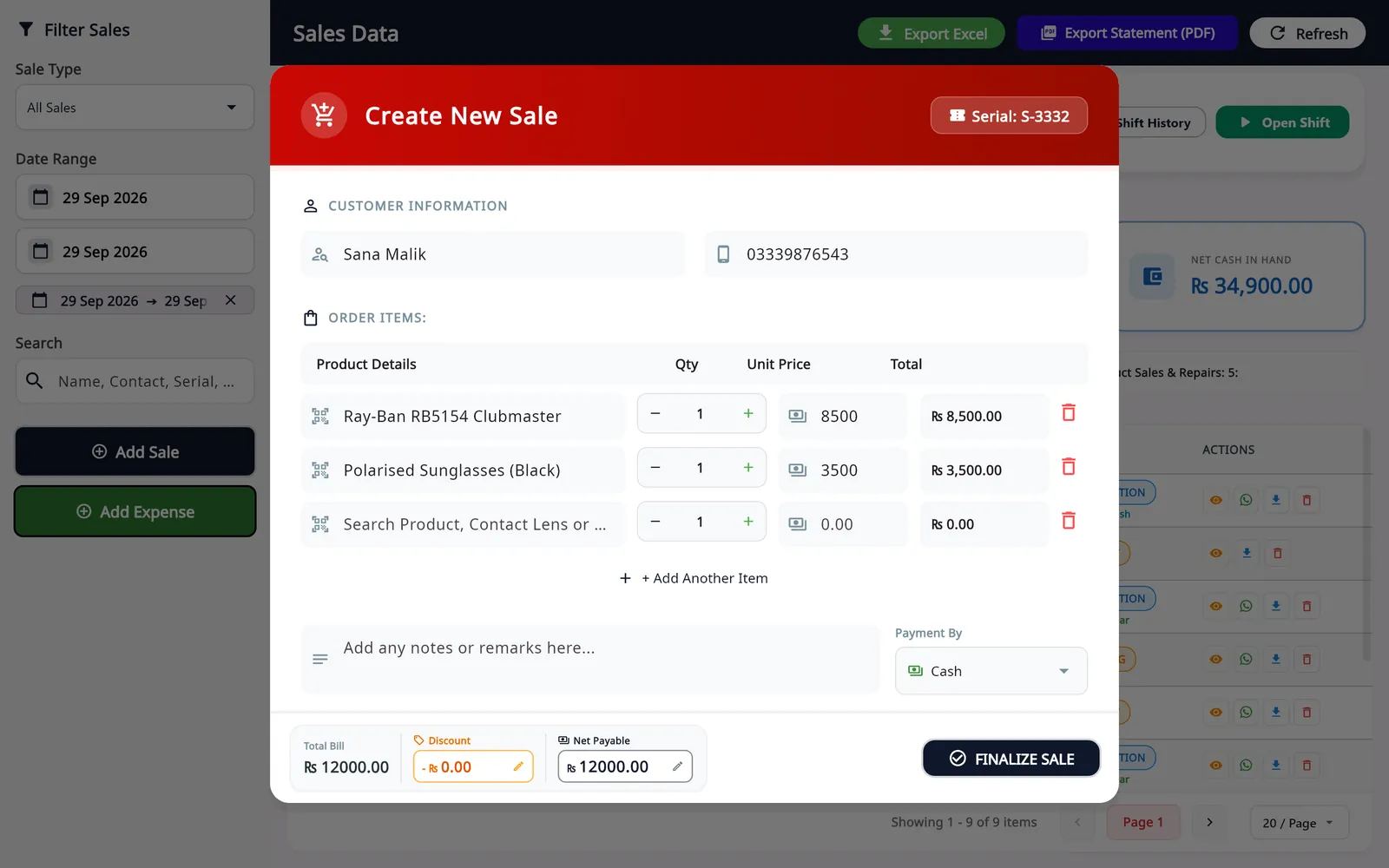
Because there is no plan register, keep a simple list of plans sold (customer, receipt number, end date, claims used) until your volume shows whether a plan is worth offering. If you want to try this workflow on your own counter, download the Windows program; it is free for the first 30 days.
Sources
Official sources, read on 1 November 2026. Quotations are from these pages.
- United States: Federal Trade Commission, Businessperson's Guide to Federal Warranty Law; and Extended Warranties and Service Contracts (consumer advice, March 2023).
- United Kingdom: Consumer Rights Act 2015, section 9, section 19, section 22, section 30 and section 31 (legislation.gov.uk); Chartered Trading Standards Institute, Business Companion, Selling and supplying goods; FCA Handbook, PERG 6: identifying contracts of insurance (the current text could not be read; an archived 2005 text was read in the PRA Rulebook).
- India: The Consumer Protection Act, 2019 (Department of Consumer Affairs; text as enacted); IRDAI, an extended warranty insurance policy wording filed by a registered insurer.
- Pakistan: The Punjab Consumer Protection Act 2005 (Punjab Code, consolidated with the 2025 amendment).
- Saudi Arabia: Insurance Authority, "Offering and selling the 'Extended Warranty' product outside licensed insurance companies constitutes a violation" (31 March 2026); Ministry of Commerce, Guide to Consumer Rights and Responsibilities (2023); Bureau of Experts, E-Commerce Law (Royal Decree M/126).
- Canada (Ontario): Returns, exchanges and warranties in Ontario (updated 25 September 2024).
Questions
- Is a protection plan the same as a warranty?
- No. A warranty or guarantee comes with the product at no extra charge, from the maker or the shop. A protection plan, extended warranty or service contract is bought separately for an extra price and covers what its written terms say, often accidental damage. Neither replaces the customer's legal rights against the shop for faulty goods.
- Can an optical shop in Saudi Arabia sell its own extended warranty?
- The Insurance Authority announced on 31 March 2026 that the extended warranty is an insurance product that only licensed and registered insurance companies may offer in the Kingdom, and that retail companies selling it without a licence break the Cooperative Insurance Companies Control Law. The announcement does not name glasses, so ask the Authority before selling any paid cover.
- Can a plan say the customer has no other rights?
- No. In the UK a contract term cannot exclude or restrict the statutory rights to goods of satisfactory quality, fit for purpose and as described (Consumer Rights Act 2015, section 31). In India a misleading guarantee is an unfair trade practice, and in Punjab liability for defective goods cannot be excluded by contract or notice. Write on the terms that the customer's legal rights are not affected.
- How should a shop price a protection plan?
- From its own records: count the repairs and remakes the plan would have covered in the last year, divide by the pairs sold, multiply by the average cost of a claim, subtract any claim fee, and add a margin. Review it after six months, because customers who buy cover often claim more than average. Ask your accountant how the plan is taxed.
- Does Asaan Optics have a protection plan feature?
- No. On the Windows desktop you can type the plan as its own line on a counter sale with its price (a typed line does not change stock), print its end date and claim fee in the sale's remarks, and record each claim as a repair job with its own receipt. There is no plan register, automatic end date or claim count.
More from the blog
- How to Manage Optical Inventory: Frames, Lenses and Contact Lenses
- Optical shop profit margins and how to calculate profitability
- Best optical shop software in 2026: five options compared
- Best optical shop software in Pakistan: what to compare
Reference guides and free calculators: Resources and optical tools.