On this page
What must a GST tax invoice from an optical shop show?
The contents of a GST tax invoice are set by Rule 46 of the CGST Rules, 2017, and the next section sets them out as the eight parts of a printed bill. Three points are specific to optical bills: the rate (frames and lenses are not taxed like sunglasses), the split between CGST and SGST or IGST, and the HSN code. For the parts that every optical invoice needs in any country, such as lens lines, advance and balance, see the general optical shop invoice checklist.
The eight parts of a GST tax invoice, top to bottom
Rule 46 lists the particulars as clauses (a) to (s). On a printed shop invoice they fall into eight areas.
- 1
Your name, address and GSTIN
The name and address you are registered under, and your 15-character GSTIN.
- 2
Serial number and date
A consecutive number of up to 16 characters, in one or more series, unique for the financial year, and the date of issue.
- 3
Customer details
A registered buyer's name, address and GSTIN. For an unregistered buyer, name, address, delivery address and state when the taxable value is ₹50,000 or more.
- 4
Item lines
The HSN code, a description, and the quantity with its unit for each item.
- 5
Value and discount
The total value of the supply and the taxable value after any discount.
- 6
GST rate and amount
The rate and amount of each tax: CGST and SGST within your state (CGST and UTGST in some Union Territories), or IGST to another state.
- 7
Total, place of supply, reverse charge
The invoice total, the place of supply with the state's name for an inter-state sale, and whether tax is payable on reverse charge.
- 8
Signature and IRN QR code
Your signature or digital signature. An e-invoice needs no signature and carries a QR code with its Invoice Reference Number.
The serial number
Rule 46(b) asks for "a consecutive serial number not exceeding sixteen characters, in one or multiple series". It may use letters, numerals, a hyphen or a slash, and it must be unique for the financial year. A pattern such as MUM/25-26/00412 fits in 15 characters and shows the branch and the year; each branch or counter can keep its own series this way. A long branch prefix can push the number past 16 characters.
Customer details
For a registered buyer, the invoice shows their name, address and GSTIN. For a walk-in customer who is not registered, Rule 46(e) makes the name, address, delivery address and state name and code mandatory only "where the value of the taxable supply is fifty thousand rupees or more". Below that, Rule 46(f) asks for them only if the customer requests it. The state you record also decides which tax applies, as the section on CGST and IGST explains.
Signature and reverse charge
Rule 46(q) asks for the "signature or digital signature of the supplier or his authorised representative", and a proviso says it is not needed on an electronic invoice. Rule 46(p) asks whether tax is payable on reverse charge. On an ordinary retail sale the answer is no, and many shops print "Reverse charge: No" so the field is never left blank.
What GST rate applies to frames, lenses and sunglasses?
Since 22 September 2025, spectacle lenses, contact lenses, frames and corrective spectacles are at 5% GST, and sunglasses and other spectacles or goggles that do not correct vision are at 18%. The 56th GST Council recommended these rates, and they are implemented by Notification No. 9/2025-Central Tax (Rate), dated 17 September 2025 (see the note below on checking it). A CGST rate notification states the central share; SGST, or UTGST, is the same again, so the total GST is twice the CGST rate.
| Item | HSN heading | GST | Within the state |
|---|---|---|---|
| Spectacle lenses | 9001 | 5% | CGST 2.5% + SGST 2.5% |
| Contact lenses | 9001 | 5% | CGST 2.5% + SGST 2.5% |
| Frames and mountings | 9003 | 5% | CGST 2.5% + SGST 2.5% |
| Corrective spectacles, including goggles for correcting vision | 9004 | 5% | CGST 2.5% + SGST 2.5% |
| Sunglasses and other spectacles or goggles that do not correct vision | 9004 | 18% | CGST 9% + SGST 9% |
Frames are not at 18%. Frames and mountings under heading 9003 are in the 5% list. Only spectacles and goggles that do not correct vision, which in an optical shop usually means plain sunglasses, are at 18%. Sunglasses made with prescription lenses correct vision, so ask your practitioner how to bill them before you price them.
The rates are also summarised, with their sources, in the GST rules section of the India page.
CGST and SGST, or IGST: which one goes on the bill?
The total rate is the same either way. What changes is how the tax is split and which government receives it. A sale where your shop and the place of supply are in the same state is intra-state: you charge CGST and SGST in equal halves. A sale where the place of supply is in another state is inter-state: you charge IGST at the full rate.
In a Union Territory without its own legislature (the Andaman and Nicobar Islands, Lakshadweep, Dadra and Nagar Haveli and Daman and Diu, Ladakh and Chandigarh), Union territory tax takes the place of SGST, so a local bill shows CGST and UTGST in the same equal halves (Union Territory Goods and Services Tax Act, 2017, sections 2(8) and 7).
So the question is always: what is the place of supply? For goods, section 10 of the IGST Act answers it. Since 1 October 2023, a special clause covers customers who are not registered.
Local walk-in customer
Their address is in your state, or you record no address. The place of supply is your state: CGST and SGST.
Visitor from another state
An unregistered customer whose address on the invoice is in another state. The place of supply is that state: IGST, even though they bought at your counter.
Glasses sent to another state
You courier the order to a delivery address in another state. The place of supply is the delivery state: IGST.
Registered buyer
A business with a GSTIN. The general rule of section 10(1)(a) applies: the place where the goods' movement ends for delivery. Ask your practitioner about a registered buyer from another state who collects at your counter.
The two IGST cases are inter-state sales, which a shop on the composition scheme may not make; see the first question in the section on which document to issue.
Good practice: record the customer's address only when you have it right. Below ₹50,000 it is needed only if the customer asks for it; once it is on the invoice, its state decides the tax. A wrong state changes the tax type, and correcting it later means a credit note and a new invoice. For an inter-state sale, Rule 46(n) also asks for the place of supply with the state's name on the invoice.
Worked example: a spectacle order at 5% and sunglasses at 18%
A customer orders single vision glasses: a frame at ₹2,000 and a pair of lenses at ₹1,500 (₹750 each), with a ₹200 discount on the frame. On the same bill they buy plain sunglasses at ₹1,800. Prices are before GST. All amounts are rounded to two decimals.
| Item | HSN | Qty | Taxable ₹ | GST |
|---|---|---|---|---|
| Frame, ₹2,000 less ₹200 discount | 9003 | 1 pc | 1,800.00 | 5% |
| Spectacle lens, right | 9001 | 1 pc | 750.00 | 5% |
| Spectacle lens, left | 9001 | 1 pc | 750.00 | 5% |
| Sunglasses, non-corrective | 9004 | 1 pc | 1,800.00 | 18% |
First, the spectacle order alone. The discount comes off before the tax: a discount given at or before the sale and recorded on the invoice is not part of the value (section 15(3)(a) of the CGST Act), and Rule 46(k) asks the invoice to show the taxable value after it.
Within your state: CGST + SGST
Frame and lenses: 2,000 + 1,500 = 3,500.00
Less discount: − 200.00
Taxable value: 3,300.00
CGST 2.5%: 3,300 × 0.025 = 82.50
SGST 2.5%: 3,300 × 0.025 = 82.50
Total: 3,300.00 + 165.00 = 3,465.00
To another state: IGST
Frame and lenses: 2,000 + 1,500 = 3,500.00
Less discount: − 200.00
Taxable value: 3,300.00
IGST 5%: 3,300 × 0.05 = 165.00
No CGST or SGST
Total: 3,300.00 + 165.00 = 3,465.00
Now the whole bill with the sunglasses, sold within the state. Where a bill carries two rates, show the taxable value and the tax for each rate, then the totals.
The full bill, within your state
5% items: taxable 3,300.00, CGST 82.50, SGST 82.50
18% items: taxable 1,800.00, CGST 9% 162.00, SGST 9% 162.00
Total taxable value: 3,300.00 + 1,800.00 = 5,100.00
Total CGST: 82.50 + 162.00 = 244.50; total SGST: 244.50
Invoice total: 5,100.00 + 489.00 = 5,589.00
Sent to another state, the same bill shows IGST 165.00 on the 5% items and IGST 324.00 on the sunglasses: IGST 489.00 and the same total of 5,589.00.
What one rate for the whole shop does to this bill
If the billing system has a single rate, the bill above comes out wrong in either direction. At 5% on everything, the tax is 5,100 × 0.05 = 255.00, which is 234.00 less than the 489.00 due, the gap on the sunglasses. At 18% on everything, the tax is 918.00, and the customer pays 429.00 too much on the glasses. This is why a shop that sells both needs a rate on each item.
Working back from a price that includes GST
Many shops display prices with GST included. The invoice must still show the taxable value and the tax, so divide the price by 1 plus the rate.
Spectacles at ₹3,500 including 5%
Taxable value: 3,500 ÷ 1.05 = 3,333.33
CGST 2.5%: 3,333.33 × 0.025 = 83.33
SGST 2.5%: 83.33
Sum: 3,333.33 + 166.66 = 3,499.99
Round off: + 0.01, total 3,500.00
Sunglasses at ₹1,800 including 18%
Taxable value: 1,800 ÷ 1.18 = 1,525.42
CGST 9%: 1,525.42 × 0.09 = 137.29
SGST 9%: 137.29
Sum: 1,525.42 + 274.58 = 1,800.00
No round off needed
A one-paisa difference like the one on the left is normal when an amount is split into halves. Shops usually show it as a round-off line rather than changing a tax figure. Your margin is earned on the taxable value, not on the price with GST, which is how the guide to optical shop margins and mark-up works it out.
Which document do I issue: tax invoice, bill of supply or e-invoice?
Work through these questions in order. Each answer comes from the CGST Act and Rules linked below.
Has your shop opted for the composition scheme?
YesIssue a bill of supply, not a tax invoice, and charge no GST. Rule 5(1)(f) requires the words "composition taxable person, not eligible to collect tax on supplies" at the top. A composition shop may not make inter-state supplies (CGST Act section 10(2)(c)), so it cannot courier glasses to another state, and an out-of-state address on a walk-in bill would make the sale inter-state. Talk to your practitioner before either.
NoYou issue tax invoices. Go to the next question.
Is the buyer registered for GST?
YesIssue a tax invoice with the buyer's name, address and GSTIN. If your aggregate turnover passed ₹5 crore in any financial year since 2017-18, it must also be an e-invoice with an IRN.
NoIssue a tax invoice to the consumer. Go to the next question.
Is it a sale under ₹200 to an unregistered customer who has not asked for an invoice?
YesYou need not issue a separate tax invoice; include the sale in one consolidated tax invoice at the close of the day (section 31(3)(b) and Rule 46).
NoIssue a tax invoice for the sale.
Is the taxable value ₹50,000 or more?
YesThe customer's name, address, delivery address and state name and code are mandatory on the invoice.
NoThey are needed only if the customer asks (Rule 46(f)). If you record a state, it still decides CGST and SGST or IGST.
Does one sale to an unregistered customer mix taxable goods with exempt supplies?
YesOne invoice-cum-bill of supply may cover both, with the particulars of both documents (Rule 46A). Ask your practitioner which of your services, if any, are exempt.
NoA tax invoice covers the whole sale.
The composition scheme has its own turnover limits and conditions; they are listed, with sources, on the India page. A bill of supply has its own list of particulars in Rule 49: no tax rate or tax amount, but still the serial number, date, HSN, description and value.
What do I issue when a customer pays an advance on a spectacle order?
Most spectacle orders are paid in two parts: an advance when the order is placed and the balance when the glasses are collected. GST law has a document for each step.
The advance: a receipt voucher.
On receiving an advance for any supply, a registered person issues "a receipt voucher or any other document" showing the payment (section 31(3)(d) of the CGST Act). Rule 50 lists what it shows, including your GSTIN, a consecutive serial number unique for the financial year, the date, a description and the amount of the advance.
The glasses handed over: the tax invoice.
For goods that the customer collects, the tax invoice is issued before or at the time of delivery (section 31(1)). It carries the full value of the order and its GST.
The balance.
The customer pays what is left. Good practice: show the advance already received and the balance on the invoice or the payment receipt, so the two documents match.
When is the GST due? For goods, a registered person who has not opted for composition pays tax at the time of supply under section 12(2)(a), the date of the invoice, and not when the advance is received (Notification No. 66/2017-Central Tax). That relief covers goods only: an advance for a service, such as a repair, follows different timing. Ask your practitioner how to show tax on your receipt vouchers, and how a composition shop treats advances.
How many HSN digits does the invoice need?
It depends on your aggregate turnover in the previous financial year, under Notification No. 78/2020-Central Tax, in force since 1 April 2021.
| Turnover, previous year | To a registered buyer | To an unregistered customer |
|---|---|---|
| Up to ₹5 crore | 4 digits, e.g. 9003 | May be left out |
| More than ₹5 crore | 6 digits | 6 digits |
The relief for sales to unregistered customers applies only up to ₹5 crore; the notification gives none above it. Good practice: print the HSN on every line anyway. It costs nothing, and it makes the rate on each line easy to check, which matters when a bill carries both 5% and 18% items. Six-digit codes below the heading level come from the customs tariff; ask your practitioner which ones fit your products.
When does an optical shop need an e-invoice (IRN)?
Only if your turnover is above ₹5 crore, and only for some sales. E-invoicing applies to registered persons whose aggregate turnover exceeded ₹5 crore in any preceding financial year from 2017-18, for their supplies to registered persons and for exports. The rule is Notification No. 13/2020-Central Tax; Notification No. 70/2020-Central Tax added exports and the test from 2017-18, and Notification No. 10/2023-Central Tax lowered the threshold to ₹5 crore from 1 August 2023. Walk-in sales to consumers are outside it.
From 1 January 2027, Notification No. 04/2026-Central Tax also brings in self-invoices for reverse-charge purchases from unregistered suppliers and imports of services, with the same threshold. Those are purchases, not counter sales.
For an optical shop above ₹5 crore, the B2B sales are things like a company buying safety or prescription glasses for its staff, or frames sold to another optician. For each of those, the invoice is reported to the Invoice Registration Portal (IRP) before it is handed over:
- Step 1
Prepare the invoice
All Rule 46 particulars, with the buyer's GSTIN.
- Step 2
Report it to the IRP
The invoice details are uploaded in the FORM GST INV-01 format.
- Step 3
Receive the IRN
The IRP returns an Invoice Reference Number and a signed QR code.
- Step 4
Issue the invoice
Print or send it with the QR code; no signature is needed.
Under Rule 48(4) and (5), an invoice that a notified person issues without this step "shall not be treated as an invoice". Two further points apply only to large businesses:
- B2C dynamic QR code: a registered person whose aggregate turnover in a financial year exceeds ₹500 crore must put a dynamic QR code on invoices to unregistered customers (Notification No. 14/2020-Central Tax).
- 30-day reporting limit: a GSTN advisory dated 5 November 2024 says that from 1 April 2025, taxpayers with an annual aggregate turnover of ₹10 crore or more cannot report an invoice, credit note or debit note to the IRP once it is more than 30 days old. This is a portal rule set by an advisory, not a section of the Act, so check the GST portal for the current position.
How many copies of the invoice do I need?
For goods, Rule 48(1) says the invoice is prepared in triplicate, marked:
- "ORIGINAL FOR RECIPIENT", the customer's copy;
- "DUPLICATE FOR TRANSPORTER", which travels with goods that are transported;
- "TRIPLICATE FOR SUPPLIER", your copy.
This does not apply to an e-invoice prepared through the IRP (Rule 48(6)).
Good practice: keep your copy as a PDF or in your billing software as well as on paper. Thermal receipts fade, and you will need the record when your practitioner prepares returns or a tax officer asks for an invoice.
Common GST invoice mistakes in optical shops
Run through this list with a few real bills from last month.
Check your bills for these
- Sunglasses billed at 5% because the system has one rate, or frames billed at 18% by mistake.
- CGST and SGST charged on glasses couriered to another state, where IGST applies.
- An out-of-state address recorded on a walk-in bill, but CGST and SGST charged instead of IGST.
- Serial numbers that restart in the middle of the year, repeat across counters, or run past 16 characters.
- The discount taken off after the tax instead of before it.
- No HSN code on an invoice to a registered buyer.
- A registered buyer's GSTIN missing or mistyped, so they cannot match the invoice.
- No name, address and state on a sale to an unregistered customer of ₹50,000 or more.
- A composition shop showing GST on its bills instead of issuing a bill of supply, or selling to another state.
- An advance taken on an order with no receipt voucher.
- A B2B invoice issued without an IRN by a shop above the ₹5 crore e-invoice threshold.
What Asaan Optics does and does not do for GST
Asaan Optics is the optical shop software we make, for Windows and Android. It handles counter work such as prescription orders, receipts and daily cash, with frame and lens stock kept on the Windows desktop. It does not produce GST tax invoices; the table shows where it stops.
| What a GST invoice needs | Asaan Optics receipt |
|---|---|
| Your name, address and registration number | Printed, with the number under "Tax Reg No"; the number is free text with no GSTIN check |
| Consecutive invoice number, unique for the financial year, and date | A number and date are printed. Prescription orders saved online get a running number, but counter-sale numbers are short codes that are not consecutive, and no series restarts each financial year |
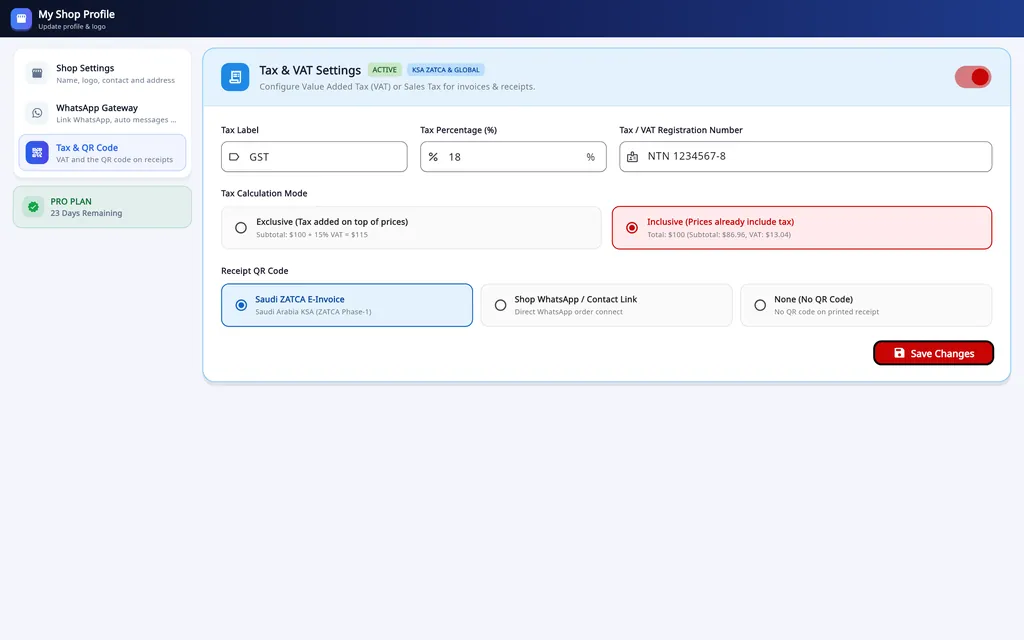
| Discount, total before tax, tax line | One tax line with your label, such as GST, and one rate; the subtotal line reads "Total before VAT" |
| A rate per item (5% and 18%) | One rate for the whole shop |
| HSN code per item | Not kept |
| CGST and SGST, or IGST | Not split |
| Buyer GSTIN and place of supply | Not recorded |
| E-invoice (IRN), e-way bill, GST returns | Not produced |
In practice: you can name the tax GST, set one rate for the shop, choose whether prices include it, and print your registration number. Because frames and lenses are at 5% and sunglasses at 18%, a single shop rate cannot price both correctly, as the worked example shows. A shop that needs GST tax invoices should issue them from GST or accounting software and use Asaan Optics alongside it for the counter work, and should check with its practitioner which document goes to the customer. The settings are described on the VAT, GST and tax settings page, and what the app does for shops in India is on the India page.
The short version
Useful next steps
 In Asaan OpticsVAT, GST and ZATCA settingsYour own tax label, one rate and your registration number on the receipt; ZATCA Phase 2 on the Windows desktop and the Android app for Saudi shops.See how it works
Questions and answers
Can my shelf tags show prices including GST?
Yes. Many shops tag prices with GST included. The tax invoice must still show the taxable value and the rate and amount of each tax, so work back from the tagged price by dividing it by 1.05 or 1.18.
Do I charge GST on the advance a customer pays for spectacles?
For goods, a GST-registered shop that is not on the composition scheme pays the tax when the tax invoice is issued, not when the advance comes in (Notification No. 66/2017-Central Tax). You still give the customer a receipt voucher for the advance, and the tax invoice with the full GST when the glasses are handed over. Advances for services, such as a repair, follow different timing, so ask your practitioner.
Which GST rate applies to ready-made reading glasses?
Reading glasses correct near vision, which points to the corrective spectacles entry under heading 9004 at 5%. Classification decides the rate, so confirm it with your GST practitioner before you bill them.
Can I still write GST invoices in a printed bill book?
Rule 46 lists the contents of a tax invoice, not the way it is produced, so a bill book with every required field and consecutive serial numbers can work for a shop outside e-invoicing. Once your turnover passes the ₹5 crore e-invoice threshold, invoices to registered buyers must be reported to the IRP, which a bill book cannot do.
Do I have to print the customer's phone number on a GST invoice?
No. A phone number is not one of the Rule 46 particulars. Record it on the order anyway, because you need it to tell the customer when the glasses are ready.
Sources and references
Official and primary sources used for this article. Rules change: check the source before you rely on it.
Central Board of Indirect Taxes and Customs (CBIC), Government of India
Rule 46: Tax invoice, Central Goods and Services Tax Rules, 2017
The particulars of a tax invoice, clauses (a) to (s): serial number, the ₹50,000 rule for unregistered buyers in (e) and (f), taxable value after discount, rate and amount of central, State, integrated or Union territory tax, place of supply, reverse charge, signature, the IRN QR code, and the consolidated daily invoice. Latest amendment shown: Notification 20/2024-CT, effective 1 November 2024.
Checked 3 November 2026
Central Board of Indirect Taxes and Customs (CBIC), Government of India
Section 31: Tax invoice, Central Goods and Services Tax Act, 2017
31(1): for goods, the tax invoice is issued before or at removal or delivery; 31(3)(b): no separate tax invoice needed for supplies under two hundred rupees, on conditions; 31(3)(c): exempt and composition suppliers issue a bill of supply; 31(3)(d): a receipt voucher on receiving an advance.
Checked 3 November 2026
Central Board of Indirect Taxes and Customs (CBIC), Government of India
Rule 50: Receipt voucher, CGST Rules, 2017
The particulars of a receipt voucher for an advance: GSTIN, consecutive serial number, date, recipient, description, amount of advance, tax rate and amount, place of supply, reverse charge, signature.
Checked 3 November 2026
Central Board of Indirect Taxes and Customs (CBIC), Government of India
Section 12: Time of supply of goods, Central Goods and Services Tax Act, 2017
12(2)(a): the date of issue of the invoice, or the last date by which it should be issued; 12(2)(b): the date payment is received.
Checked 3 November 2026
Central Board of Indirect Taxes and Customs (CBIC), via the GST Council
Notification No. 66/2017-Central Tax, 15 November 2017: tax on goods at the time of supply
Registered persons not in the composition scheme pay tax on outward supplies of goods at the time in section 12(2)(a), so not on an advance received for goods. Original text read; later amended by Notification 50/2023-Central Tax (specified actionable claims), which was not read.
Checked 3 November 2026
Central Board of Indirect Taxes and Customs (CBIC), Government of India
Section 15: Value of taxable supply, Central Goods and Services Tax Act, 2017
15(3)(a): a discount given before or at the time of supply and recorded on the invoice is not part of the value.
Checked 3 November 2026
Central Board of Indirect Taxes and Customs (CBIC), Government of India
Section 10: Composition levy, Central Goods and Services Tax Act, 2017
10(2)(c): a composition taxpayer may not make inter-State outward supplies of goods or services.
Checked 3 November 2026
Central Board of Indirect Taxes and Customs (CBIC), Government of India
Rule 46A: Invoice-cum-bill of supply, CGST Rules, 2017
One document for taxable and exempt supplies to an unregistered person, with the particulars of both.
Checked 3 November 2026
Central Board of Indirect Taxes and Customs (CBIC), Government of India
Rule 48: Manner of issuing invoice, CGST Rules, 2017
48(1): goods invoices in triplicate (original for recipient, duplicate for transporter, triplicate for supplier); 48(4) and 48(5): notified persons report invoices to the IRP for an IRN, or the document is not an invoice; 48(6): sub-rules (1) and (2) do not apply to such e-invoices.
Checked 3 November 2026
Central Board of Indirect Taxes and Customs (CBIC), Government of India
Rule 49: Bill of supply, CGST Rules, 2017
The particulars of a bill of supply, issued by exempt suppliers and composition taxpayers.
Checked 3 November 2026
Central Board of Indirect Taxes and Customs (CBIC), Government of India
Rule 5: Conditions and restrictions for composition levy, CGST Rules, 2017
5(1)(f): the words "composition taxable person, not eligible to collect tax on supplies" at the top of the bill of supply.
Checked 3 November 2026
Press Information Bureau, Ministry of Finance, hosted by the GST Council
FAQs on the decisions of the 56th GST Council meeting (3 September 2025)
Question 1: the new goods rates apply from 22 September 2025. Question 53: spectacles and goggles for correcting vision at 5%; spectacles and other goggles not for correcting vision stay at 18%.
Checked 3 November 2026
Press Information Bureau, Ministry of Finance, hosted by the GST Council
Annexure II, 12% to 5%: 9001 contact lenses and spectacle lenses, 9003 frames and mountings (miscellaneous items), 9004 spectacles and goggles for correcting vision (health sector). Goods rate changes from 22 September 2025.
Checked 3 November 2026
CBIC tax information portal, Government of India
Notification No. 9/2025-Central Tax (Rate), 17 September 2025: CGST rates on goods
The rate notification that implements the 56th Council rates. This copy could not be opened on 3 November 2026 (the connection was reset), so the rates in the article rest on the two GST Council documents above; check the notification and its amendments yourself.
Checked 3 November 2026
Central Board of Indirect Taxes and Customs (CBIC), Government of India
10(1)(a): where goods move, the place where the movement ends for delivery; 10(1)(ca): for an unregistered buyer, the address recorded on the invoice, or the supplier's location if none is recorded. The CBIC page still marks (ca) as awaiting commencement; Circular 209/3/2024 below says it is in force from 1 October 2023.
Checked 3 November 2026
Central Board of Indirect Taxes and Customs (CBIC), Government of India
Union Territory Goods and Services Tax Act, 2017
Section 2(8): the Union territories it covers (Andaman and Nicobar Islands, Lakshadweep, Dadra and Nagar Haveli and Daman and Diu, Ladakh, Chandigarh, other territory); section 7(1): Union territory tax on intra-State supplies. Copy dated 27 March 2020.
Checked 3 November 2026
Central Board of Indirect Taxes and Customs (CBIC), via the GST Council
Circular No. 209/3/2024-GST: place of supply of goods to unregistered persons
Reproduces section 10(1)(ca), in force from 1 October 2023; recording the state counts as recording the address; where billing and delivery addresses differ, the delivery address decides. Dated 26 June 2024.
Checked 3 November 2026
Central Board of Indirect Taxes and Customs (CBIC), via the GST Council
Notification No. 78/2020-Central Tax, 15 October 2020: HSN digits on invoices
From 1 April 2021: 4 digits up to ₹5 crore turnover, 6 digits above; up to ₹5 crore the HSN may be left off invoices to unregistered persons.
Checked 3 November 2026
Central Board of Indirect Taxes and Customs (CBIC), via the GST Council
Notification No. 13/2020-Central Tax, 21 March 2020: who must issue e-invoices
The original notification under rule 48(4), for supplies to registered persons. Its threshold and scope were later amended by the notifications below.
Checked 3 November 2026
Central Board of Indirect Taxes and Customs (CBIC), via the GST Council
Notification No. 70/2020-Central Tax, 30 September 2020: e-invoicing scope
Amends 13/2020: "any preceding financial year from 2017-18 onwards" replaces "a financial year", and "or for exports" is added.
Checked 3 November 2026
Central Board of Indirect Taxes and Customs (CBIC), via the GST Council
Notification No. 10/2023-Central Tax, 10 May 2023: e-invoice threshold of ₹5 crore
Amends 13/2020: "five crore rupees" replaces "ten crore rupees" from 1 August 2023.
Checked 3 November 2026
CBIC tax information portal, Government of India
Notification No. 04/2026-Central Tax, 26 October 2026: e-invoicing scope from 1 January 2027
Amends 13/2020 to add supplies received from unregistered persons under reverse charge and imports of services, from 1 January 2027. The CBIC viewer did not display the text on 3 November 2026; the wording was read from a copy of the gazette notification (G.S.R. 918(E)).
Checked 3 November 2026
Central Board of Indirect Taxes and Customs (CBIC), via the GST Council
Notification No. 14/2020-Central Tax, 21 March 2020: dynamic QR code on B2C invoices
Registered persons with aggregate turnover above ₹500 crore in a financial year put a dynamic QR code on invoices to unregistered persons.
Checked 3 November 2026
Goods and Services Tax Network (GSTN), copy hosted by the Maharashtra GST Department
Dated 5 November 2024: a 30-day limit from 1 April 2025 for taxpayers with AATO of ₹10 crore or more. An advisory, not a rule. The copy could not be opened on 3 November 2026; the summary was checked against published reports of the advisory.
Checked 3 November 2026