The short answer
There is no single figure for the cost of starting an optical shop. Two shops of the same size can need very different amounts because three decisions change the total more than anything else:
- Where the shop is. Rent, the advance or deposit a landlord asks for, and the fit-out a location expects (a mall unit needs more than a shop on a market street).
- Whether you test eyes in the shop. A shop that only fills prescriptions written elsewhere needs far less equipment, and no testing room, than a shop with a qualified person testing eyes.
- Whether you fit lenses yourself or send them to a lab. An edger is a large one-time cost; a lab charges you for every job instead.
Once those three are decided, the budget is a list you can fill in: one-time costs, opening stock, and enough cash to pay the monthly costs until sales cover them. The rest of this guide goes through each part, gives listed prices for the main equipment from one supplier as a reference, and ends with a worksheet you can copy.
The US Small Business Administration (SBA) splits a start-up budget into one-time costs and monthly costs, and advises: "You'll want to count at least one year of monthly expenses, but counting five years is ideal." That advice holds for an optical shop in Lahore, Pune or Jeddah as much as anywhere.
Decide the shop model first
Write down which of these three models you are opening before you ask anyone for a quote. Every later number depends on it.
| Model | What happens in the shop | Main equipment | What it changes in the budget |
|---|---|---|---|
| Dispensing only | The customer brings a prescription. You sell the frame, take measurements, order or fit the lenses. | Lensmeter, PD ruler or pupillometer, frame heater, hand tools, ultrasonic cleaner. | Lowest equipment cost. No testing room. Lens fitting is usually sent to a lab. |
| Dispensing with eye testing | A qualified person tests eyes and writes the prescription; you dispense it. | The above, plus a trial lens set and trial frame, a vision chart, and often an auto-refractometer. | A testing room, the equipment, and the salary of a qualified examiner. |
| Testing and in-house fitting | As above, and you cut and fit stock lenses into frames yourself. | The above, plus a lens edger (hand or automatic) and its consumables. | The highest one-time cost; lower lab bills per job and faster delivery for stock lenses. |
Who may test eyes, and with what qualification, is set by law and differs from country to country. If you plan to offer eye tests, confirm with your health regulator what the person doing them needs before you budget for the room and the equipment.
One-time costs
These are paid once, before or in the first weeks after opening.
- Premises. The deposit or advance rent the landlord asks for, any key money where that is the local custom, and the agent's fee. Write it as months of rent: "3 months' rent as deposit" is easier to compare between locations than a lump sum.
- Fit-out. Frame display walls or cabinets, lighting, mirrors, the counter, seating, a lockable store for stock, signage, and a testing room if you test eyes. Get at least two quotes from a local contractor; this is the line that grows most when it is not written down.
- Equipment. Listed in the next section, by shop model.
- Counter hardware. A computer, a receipt printer, and if you label stock, a barcode label printer and a scanner. A UPS keeps the counter working in a power cut.
- Opening stock. Frames, stock lenses, contact lenses and solutions, sunglasses, cases and cloths. Covered in its own section below.
- Registration and professional fees. Business and tax registration, municipal or trade licences, and an accountant to set them up. See the section on registration.
- Opening marketing. Signboard, a map listing for the shop, printed cards, and any opening offer.
Equipment and what it costs
Equipment prices depend on the brand, whether the unit is new or used, import duty, and whether the price includes installation and after-sales service. To give a reference point rather than a guess, the table below shows the prices listed by one Indian medical equipment supplier, Medikabazaar, when we checked on 22 October 2026. Prices are in Indian rupees (1 lakh = 100,000). Some listings include GST and some do not, and prices change; ask local distributors for quotes in your own country before you budget.
| Item | Needed for | Listed price at one supplier, India, 22 Oct 2026 |
|---|---|---|
| Manual lensmeter | Every model: checks the power of finished glasses and of a customer's old pair | ₹6,299 to ₹16,800 (four models) |
| Automatic lensmeter | Every model, as a faster alternative to a manual one | ₹63,000 to ₹64,103 (three models) |
| Trial lens set | Eye testing | ₹2,729 to ₹21,000 (first page of listings) |
| Auto-refractometer | Eye testing (gives a starting measurement for the examiner) | ₹1.5 lakh to ₹2.52 lakh (four models) |
| Hand edger | In-house fitting, by hand | About ₹12,247 for one model, including 18% GST |
| Automatic lens edger | In-house fitting at volume | About ₹1.70 lakh for one model, including 18% GST |
The sources for each row are listed at the end of this page. The table does not cover the vision chart, trial frame, frame heater, hand tools, PD ruler or ultrasonic cleaner, which are smaller items; add them from your own quotes.
Questions to ask before buying
- Who services it, and where? A machine with no service engineer in your city can stand idle for weeks.
- Is calibration included, and how often is it needed? A lensmeter you cannot trust is worse than none.
- What does the price include? Tax, delivery, installation, training, and for an edger the first set of wheels or blades.
- New or used? Used equipment can be much cheaper, but ask for the service history and whether a warranty comes with it.
Edger or lab: a quick payback check
An edger pays for itself only through the fitting charges you no longer pay the lab. Work it out with your own numbers:
Monthly saving = (pairs you would fit yourself each month × lab fitting charge per pair) − monthly running cost (wheels, power, breakages, staff time)
Payback in months = edger price ÷ monthly saving
Example figures, not market data: 60 pairs a month × 300 = 18,000 in lab charges; running cost 6,000; saving 12,000 a month. An edger costing 400,000 then takes about 33 months to pay back. If that is longer than you are willing to wait, start with a lab and revisit the decision when your volume grows. Progressive and other lab-made lenses still go to the lab either way.
Opening stock: frames, lenses and contact lenses
Opening stock is usually the largest single cash item after premises and fit-out, and the easiest to overspend on. Set a stock budget first, then fill it, rather than the other way round.
Frames
Decide your price bands (for example budget, middle and premium) and how many pieces you want to show in each. The budget is then:
Frame budget = Σ (pieces in each band × average cost per piece in that band)
Show variety rather than depth: one piece of each model and colour is enough to display, and you can reorder what sells. The guide to managing optical inventory explains how to record each model, colour and size so you can see later which ones sold.
Stock lenses
Keep only the single vision powers you expect to dispense every week, as single pieces, not pairs. Higher powers, progressives and special coatings are better ordered for each job from the lab: they are a cost against one customer's order, not money waiting on a shelf.
Contact lenses and solutions
A box that expires on the shelf is a total loss. Open with a small range of the commonest powers and order the rest when a customer needs them.
Accessories
Cases, cleaning cloths, sprays, chains and repair parts cost little each but add up; include them in the stock budget.
Where you buy also matters. In Pakistan, our Roman Urdu guide to optical shop location and wholesale buying lists the questions to ask a wholesale supplier before the first order.
Monthly running costs
These come every month whether or not you sell anything. Write each one down for the first twelve months.
| Cost | Fixed or variable | Note |
|---|---|---|
| Rent and service charges | Fixed | Ask how often and by how much rent rises. |
| Salaries | Fixed | Including your own if you will draw one, and the examiner if you test eyes. |
| Electricity, internet, phone | Mostly fixed | An edger and air conditioning raise the electricity bill. |
| Software and subscriptions | Fixed | Billing and stock software, accounting, map and website listings. |
| Marketing | Fixed (your choice) | Decide a monthly amount and keep to it. |
| Maintenance and calibration | Fixed (averaged) | Divide the yearly cost by twelve. |
| Lab bills, frames and lenses sold | Variable | These rise and fall with sales; they are the cost of goods, covered in the margins guide. |
| Card and bank charges | Variable | A percentage of card sales. |
For software, our page on what optical shop software costs lists the published prices of eleven products, with a link to each maker's page.
Registration, licences and tax
The registrations a shop needs depend on the country, the city and whether eyes are tested on the premises, and they change. We did not find a single official checklist for optical shops in Pakistan, India or Saudi Arabia, so this section lists what to ask about rather than a list of fees. Your accountant and the local authority have the current answer. This is not tax or legal advice.
- Business registration and trade licence from the city or municipal authority.
- Tax registration. Three examples of rules that affect an optical shop:
- In Saudi Arabia, ZATCA says VAT registration is required for those whose annual revenue exceeds SAR 375,000 and is optional above SAR 187,500, and its invoicing guideline gives the standard VAT rate as 15%.
- In India, the GST rate on spectacles and lenses was cut from 12% to 5% in September 2025, as reported by All India Radio. Check the rate for each product you sell with your GST adviser, since frames, sunglasses and contact lenses are listed separately.
- In Pakistan, retailers that fall under FBR's "Tier-1" definition must connect their point of sale to FBR. Ask FBR or a tax adviser whether your shop qualifies before choosing software. Asaan Optics does not connect to FBR's invoicing system.
- Health registration for anyone who tests eyes, if your country requires it.
- Signboard permission, where the city charges for it.
Working capital: the money that is easy to forget
Working capital is the cash that pays rent and salaries in the months before sales are high enough to cover them. Many budgets list the fit-out and stock carefully and leave this out.
Working capital = monthly fixed costs × the number of months you expect sales to fall short
Two features of optical retail make this cash more important than in many shops:
- Customers pay in two parts. An advance when the order is placed and the balance at collection. Until the glasses are collected, part of the sale is money owed to you, not money in the drawer.
- Labs and suppliers want paying. Credit terms with a lab or wholesaler help, but every unpaid bill is a debt you have to plan for.
To estimate how much you must sell each month to cover your costs, use the break-even formula in our guide to optical shop profit margins. The gap between that figure and what you expect to sell in the first months is what working capital has to cover.
A start-up worksheet with a worked example
Copy the first two columns and fill in your own figures. The third column is an example to show the arithmetic, not market data: round numbers in no particular currency for a dispensing shop with eye testing and no edger. Replace every figure with your own quotes.
| Line | How to work it out | Example figures (not market data) |
|---|---|---|
| Deposit or advance rent | Months asked × monthly rent | 3 × 80,000 = 240,000 |
| Fit-out and signage | Contractor quotes | 600,000 |
| Equipment | Sum of quotes for your shop model | 450,000 |
| Counter hardware | Computer, receipt printer, label printer, scanner, UPS | 150,000 |
| Frames | Pieces × average cost per band | 200 × 1,500 = 300,000 |
| Stock lenses | Pieces × average cost | 200 × 250 = 50,000 |
| Contact lenses and solutions | Small opening range | 40,000 |
| Sunglasses and accessories | Pieces × average cost | 60,000 |
| Registration and professional fees | Published fees plus accountant | 50,000 |
| Opening marketing | Your decision | 50,000 |
| One-time total | Sum of the lines above | 1,990,000 |
| Monthly fixed costs | Rent 80,000 + salaries 90,000 + utilities 20,000 + software 6,000 + marketing 10,000 + other 14,000 | 220,000 a month |
| Working capital | Monthly fixed costs × months of shortfall | 220,000 × 4 = 880,000 |
| Contingency | About 10% of the two totals above | 287,000 |
| Money needed to open | One-time total + working capital + contingency | 3,157,000 |
The contingency line follows the SBA's suggestion to add "a little extra, say 10%" for miscellaneous expenses you cannot predict. Four months of shortfall is an assumption for the example; your own number comes from comparing your expected monthly sales with your break-even sales.
Keeping track of the money after you open
The budget is only useful if you compare it with what actually happens. Each month, check three things against the worksheet: what you spent, what you sold, and what customers and suppliers still owe or are owed.
If you use Asaan Optics, the desktop software records expenses from the Sales & POS screen next to the day's sales, and the dashboard shows the month's revenue, the pending balances customers still owe, and store expenses on one screen. The Stock Control Center shows what your stock is worth at cost and at retail.
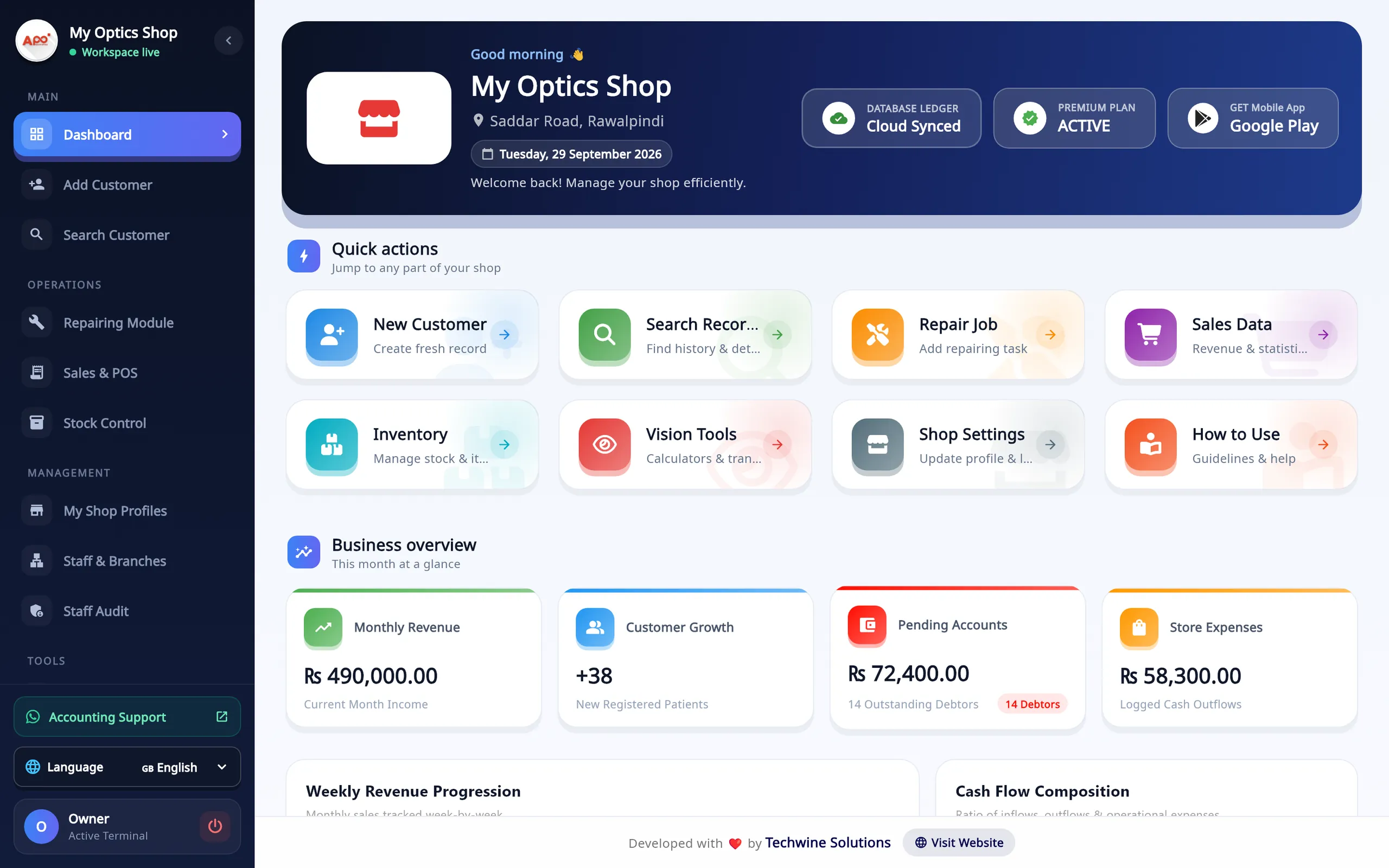
Software is one line in the budget, not the reason a shop succeeds. If you want to try the screens described here while you plan, the Asaan Optics desktop software is free for its first 30 days.
Sources
- U.S. Small Business Administration, Calculate your startup costs: one-time and monthly costs, "at least one year of monthly expenses", and the 10% cushion. Read 22 October 2026.
- Medikabazaar (India), listed prices read 22 October 2026: lensmeters; trial lens sets; auto-refractometers; Optilab Popular hand edger; Jinglian automatic lens edger. One supplier's prices on one day, shown as a reference, not as a market average.
- ZATCA, VAT registration for individuals: SAR 375,000 and SAR 187,500 thresholds. Read 22 October 2026.
- ZATCA, Guideline for Tax Invoicing and Records under VAT Provisions: the 15% standard rate. Read 22 October 2026.
- All India Radio News, GST on spectacles and lenses reduced to 5%, 14 September 2025.
Questions
- Can I open an optical shop without eye testing equipment?
- Yes. A dispensing-only shop fills prescriptions written elsewhere, so it needs a lensmeter, measuring tools, a frame heater and hand tools, but no testing room, trial lens set or auto-refractometer. Who may test eyes, and with what qualification, is set by law in each country, so check with your health regulator before adding testing later.
- Should a new optical shop buy a lens edger or use a lab?
- Compare the edger's price with what it saves. Monthly saving is the pairs you would fit yourself each month times the lab's fitting charge, minus running costs such as wheels, power, breakages and staff time. Divide the edger's price by that saving to get the months it takes to pay back. If the answer is several years, start with a lab and look again when volume grows.
- How many frames should a new optical shop stock?
- There is no correct number. Set a stock budget first, divide it into price bands, and divide each band's money by the average cost of a frame in it. Show one piece of each model and colour rather than several of the same, and reorder what sells.
- How much working capital does an optical shop need?
- Enough to pay the monthly fixed costs, such as rent and salaries, for the months before sales cover them. Multiply your monthly fixed costs by the number of months you expect to fall short. The US Small Business Administration advises budgeting at least one year of monthly expenses when you plan a new business.
More from the blog
- How to Manage Optical Inventory: Frames, Lenses and Contact Lenses
- Optical shop profit margins and how to calculate profitability
- Best optical shop software in 2026: five options compared
- Best optical shop software in Pakistan: what to compare
Reference guides and free calculators: Resources and optical tools.