 asaanoptics_admin
 In the highly competitive world of independent optometry and optical retail, business efficiency is the dividing line between thriving practices and struggling clinics. Yet, many practice managers continue to run their dispensaries using generic, off-the-shelf retail software designed for coffee shops or clothing boutiques. The reality is that utilizing a standard retail system creates hidden operational drains that quietly erode your bottom line. Transitioning to a dedicated optical POS is no longer just a technology upgrade; it is a clinical and financial necessity. When your front-desk scheduler, clinical EHR, and optical dispensary do not communicate seamlessly, patients fall through the cracks, inventory leaks capital, and opticians waste valuable time translating prescription details into retail line items.
As an optical practice manager, you are responsible for balancing patient care with robust commercial performance. Every manual touchpoint in your dispensing workflow introduces a margin of error. From miskeyed cylinder values to miscalculated vision plan co-pays, the cost of utilizing fragmented systems is far higher than most practice owners realize. Let’s dive deep into the specific operational bottlenecks caused by generic platforms and explore how a tailored software solution can transform your daily practice efficiency.
The Anatomy of a Broken Hand-Off: Why Standard Software Fails the Optical POS Test
The journey from the exam lane to the optical dispensary is the most critical phase of the patient experience. The optometrist has built trust, conducted a thorough ocular health exam, and determined the optimal corrective lens prescription. However, if the transition to the optical dispensary is disjointed, that hard-earned trust can quickly evaporate.
In a practice relying on a generic point of sale, this hand-off is often manual and fragmented. The optician must read a paper prescription slip or copy data out of an isolated Electronic Health Record (EHR) and re-enter it into the sales terminal. This lack of integration is a breeding ground for errors. A generic retail system sees a pair of prescription eyeglasses as a single inventory item or a basic parent-child variation. In reality, a single pair of progressive lenses represents a complex configuration of clinical measurements, material science, and optical physics.
Without an optical POS built to understand ophthalmic specifications, your team must manually manage dozens of prescription variables, including:
- Sphere, Cylinder, and Axis measurements
- Prism values and base directions
- Pupillary Distance (PD) and monocular fitting heights
- Segment heights and frame wrap angles
When these values are entered into a non-specialized retail terminal, the system cannot run validation checks. It has no way of knowing if a entered value is physically impossible or clinically incompatible with the selected frame. A modern optical POS bridges this gap by acting as a clinical-retail translator. It ingests clinical data directly from the EHR and populates the dispensing ticket automatically, ensuring that the optician can focus on frame styling and lifestyle dispensing rather than data entry.
The True Cost of Prescription Transposition Errors
Ophthalmic lenses must conform to highly specific manufacturing tolerances to ensure patient visual comfort and safety. According to the guidelines published by the American National Standards Institute (ANSI) under the ANSI Z80.1 standard, even minor deviations in lens power, cylinder axis, or progressive fitting heights can lead to severe asthenopic symptoms, headaches, and spatial distortion for the wearer.
If your staff is forced to manually calculate transposition or transcribe prescriptions from one format to another, errors are inevitable. For example, a simple mix-up between a plus-cylinder format and a minus-cylinder format can result in a completely unusable lens. When this occurs, the practice must absorb the cost of a lab remake, ship the frame back to the laboratory, and contact the patient to explain why their glasses are delayed. This not only destroys your profit margin on that sale but also severely damages your patient retention rate.
To eliminate these mathematical bottlenecks, opticians require built-in tools designed specifically for optical physics. Utilizing a native transposition calculator directly within your checkout pipeline ensures that prescription changes are verified digitally, instantly converting formulas without manual arithmetic. By automating these calculations inside your optical POS, you protect your staff from human error and ensure that lab orders are submitted flawlessly the first time.
For more insights on avoiding common operational pitfalls, explore our comprehensive guide on optical inventory software mistakes to keep your physical stock and laboratory orders perfectly aligned.
Beyond SKUs: Managing Complex Optical Inventory
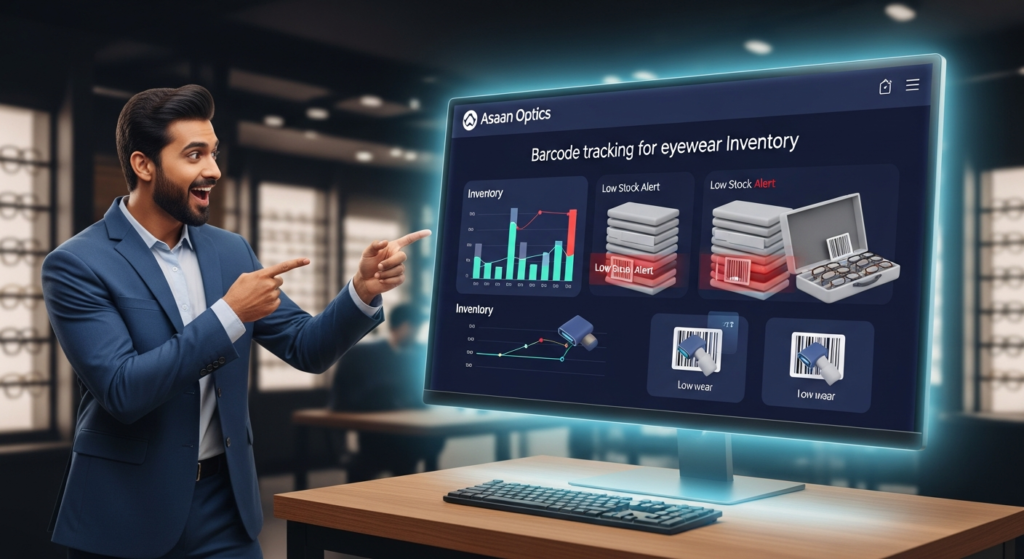
To a generic cash register system, a frame is identical to a t-shirt: it has a barcode, a price, and a brand. But to an optical practice manager, frame inventory management is a multi-layered matrix. Your inventory includes purchased stock, consignment frames (memo stock), and frame-to-come orders from external labs. Furthermore, your lens catalog consists of thousands of possible combinations of designs, materials, and treatments.
Consider the complexity of managing a modern lens catalog. A patient does not just buy a “lens.” They purchase a specific lens design (e.g., standard progressive, premium personalized progressive, single vision), manufactured in a specific material (e.g., CR-39, Polycarbonate, Trivex, 1.67 High-Index), enhanced with specific treatments (e.g., premium anti-reflective coating, blue-light filtering, photochromic transitions). If you attempt to build this matrix into a standard retail system, your inventory database quickly balloon into millions of unmanageable SKUs.
A specialized optical POS handles this complexity effortlessly. It utilizes a relational database structure where frames, lens blanks, and treatments are treated as separate, dynamic components that combine at the point of sale. This architecture allows you to:
- Track consignment stock separately from owned inventory to maintain accurate balance sheets.
- Automatically update frame stock levels the moment an order is sent to the finishing lab.
- Enforce manufacturer-specific constraints, preventing opticians from ordering lens-and-treatment combinations that cannot be physically fabricated.
By using a dedicated optician point of sale system, you gain real-time visibility into your optical dispensary’s performance. You can instantly run reports showing which frame brands have the highest turn rate, which lens materials yield the best margins, and which opticians are successfully upselling premium coatings.
The Challenge of Multi-Payer Billing and Insurance Split-Billing
One of the largest hurdles in optical retail is managing insurance. Unlike standard retail where a customer pays the listed price and walks out, optical shops operate in a complex medical-retail hybrid environment. Your staff must frequently split bills between the patient and multiple third-party payers, such as Vision Service Plan (VSP), EyeMed, or major medical insurance providers.
This is where standard point of sale systems completely break down. A generic terminal cannot calculate copays, material allowances, frame overages, or lens option deductibles. The optician is forced to open a separate tab, log into an insurance portal, calculate the patient’s out-of-pocket responsibility on a physical worksheet, and then manually override the prices in the POS. This process is slow, prone to mathematical errors, and makes the checkout experience feel clunky and unprofessional to the patient.
Integrating dedicated eyewear billing software directly into your retail workflow changes everything. A specialized system allows your staff to apply vision plan benefits directly at checkout. It automatically calculates the split billing, applying the exact frame allowance, percentage discounts on lens options, and copays based on the patient’s insurance plan. The optician can generate a clear, itemized receipt that shows the patient exactly what insurance covered and what they are responsible for paying. This transparency builds trust and significantly speeds up the checkout process.
According to research on optical retail dynamics published in the Wikipedia Optometry Portal, optical dispensaries generate up to 60% of an independent practice’s total revenue. Protecting this revenue stream requires billing software that is designed to handle both private pay and insurance claims simultaneously.
Streamlining Laboratory Communication and Order Tracking
Once a sale is completed, the work in the optical dispensary has only just begun. The order must be routed to the appropriate ophthalmic laboratory, whether you use an in-office finishing lab or a major commercial surfacing laboratory.
When using an optical POS, this process is automated. The software compiles the frame specifications, the lens measurements, and the patient’s prescription data into a standardized digital order form (such as the standard Spectacle Lens Group format). With a single click, the order is transmitted directly to the lab management system (LMS). There is no need for paper job tickets, manual faxes, or re-typing orders into proprietary lab portals. The system tracks the job’s progress in real-time, sending automatic updates to your team when the lenses are cast, surfaced, coated, edged, and shipped.
Key Operational Benefits of a Unified Optical POS
| Feature Requirement | Generic Retail POS | Specialized Optical POS |
|---|---|---|
| Prescription Validation | None. Prescriptions must be stored as text notes or external attachments. | Automated validation, cylinder transposition verification, and pupil height alignment. |
| Insurance Split-Billing | Manual overrides required. High risk of audit compliance errors. | Automatic calculation of VSP, EyeMed, and medical copays and allowances at checkout. |
| Lens Matrix Management | Requires millions of pre-configured static SKUs, leading to inventory bloat. | Dynamic, component-based pricing that combines lens design, material, and coatings instantly. |
| Lab Order Integration | No direct lab connectivity. Opticians must place orders manually. | Direct integration with major surfacing and finishing labs via standardized digital interfaces. |
Unlocking Long-Term Growth with Accurate Retail Analytics
As a practice manager, your decisions should be driven by hard data, not intuition. Generic point-of-sale software provides basic sales reports, but it cannot give you the specialized business intelligence needed to optimize an optical dispensary.
With an optical POS, you gain access to rich, industry-specific KPIs (Key Performance Indicators) that can help you steer your practice toward greater profitability. You can easily analyze:
- Capture Rate: The percentage of patients who receive an eye exam at your clinic and subsequently purchase their eyewear from your dispensary.
- Average Frame Sale Value: A metric that helps you evaluate whether your frame styling team is successfully presenting premium, designer lines.
- Lens Treatment Attachment Rate: Tracking how often anti-reflective, scratch-resistant, or photochromic treatments are added to lens sales, allowing you to identify staff training opportunities.
- Lab Turnaround Times: Monitoring how long various labs take to deliver completed jobs, helping you hold your manufacturing partners accountable.
Armed with this information, you can make informed decisions about frame purchasing, renegotiate pricing with optical laboratories, and design targeted incentive programs for your dispensing staff.
Frequently Asked Questions
What is the difference between standard POS and optical POS?
A standard retail POS system is designed for simple, static inventory transactions (like scanning a barcode on a consumer product and accepting payment). It has no capability to interpret ophthalmic prescriptions, manage multi-payer vision insurance split-billing, handle consignment frames, or communicate directly with ophthalmic surfacing laboratories. Conversely, an optical POS is engineered from the ground up specifically for eye care practices. It seamlessly integrates clinical Rx data, automates complex lens pricing matrices, calculates exact vision plan co-pays, and directly transmits structured laboratory orders to prevent remakes and manual transposition errors.
Can an optical POS system integrate with my existing clinical EHR?
Yes. A high-quality, modern point of sale system built for the optical industry is designed to integrate with leading Electronic Health Record (EHR) systems. This direct bridge allows clinical data recorded by the optometrist in the exam lane to flow automatically into the dispensary, eliminating the need for manual transcription and significantly reducing patient wait times.
How does specialized software improve the patient checkout experience?
Specialized optical software streamlines checkout by instantly calculating insurance coverage and showing the patient exactly what their vision benefits cover and what they owe out-of-pocket. It also speeds up the process by removing manual calculation steps, allowing your staff to spend more time explaining lens benefits and providing personalized, high-touch customer service.
Transform Your Dispensary’s Efficiency Today
Using a generic retail terminal in your optical practice is a hidden tax on your business. From the operational drag of manual calculations to the high cost of lab remakes caused by transcription errors, disjointed systems prevent your practice from reaching its true financial potential. By implementing a specialized, cloud-based platform that unifies prescription validation, dynamic inventory tracking, and seamless vision insurance split-billing, you protect your margins and elevate your patient care.
Are you ready to eliminate broken hand-offs, optimize your frame inventory, and empower your dispensing opticians with the tools they deserve? It’s time to step away from generic workarounds and experience the power of a system built exclusively for the modern eye care professional.
Don’t let manual errors hold your practice back any longer. Take the first step toward flawless dispensary operations and unmatched commercial efficiency.